


Which Carbon Fiber Upgrades Are Worth the Money?
Quick Summary

Front air dams and splitters give the biggest visible upgrade with a real aero reason behind it, while full aero kits suit owners planning serious track time. Carbon fiber upgrades only earn their cost when the part is engineered for your exact model and built with dry, autoclave-cured carbon rather than a cosmetic overlay.
- Front air dams and splitters reduce front-end lift and support steering response at speed.
- Dry pre-preg carbon cured in an autoclave delivers the strength and rigidity you're paying for.
- A cosmetic carbon overlay over fiberglass adds little strength and often weighs more.
- Full aero kits work as a system, so buy one only if you will use the downforce.
- Check model fitment notes before ordering, since some parts only fit certain trims.
Table of Contents
- Why Carbon Fiber? The Looks, the Weight and the Real Story
- How Carbon Fiber Improves Your Car's Look and Stance
- Weight Savings and the Strength-to-Weight Ratio Explained
- Aero Kits, Splitters and Wings: Ranking the Upgrades That Matter
- Carbon Fiber Hood with UV Protection: What to Check Before You Buy
- How to Protect Carbon Fiber from UV Damage and Peeling
- Carbon Fiber Car Parts Maintenance: Keeping the Finish Sharp
- Picking Your First Carbon Fiber Upgrade at Merrick Motorsports
- Frequently Asked Questions
Last Updated: November 23, 2026
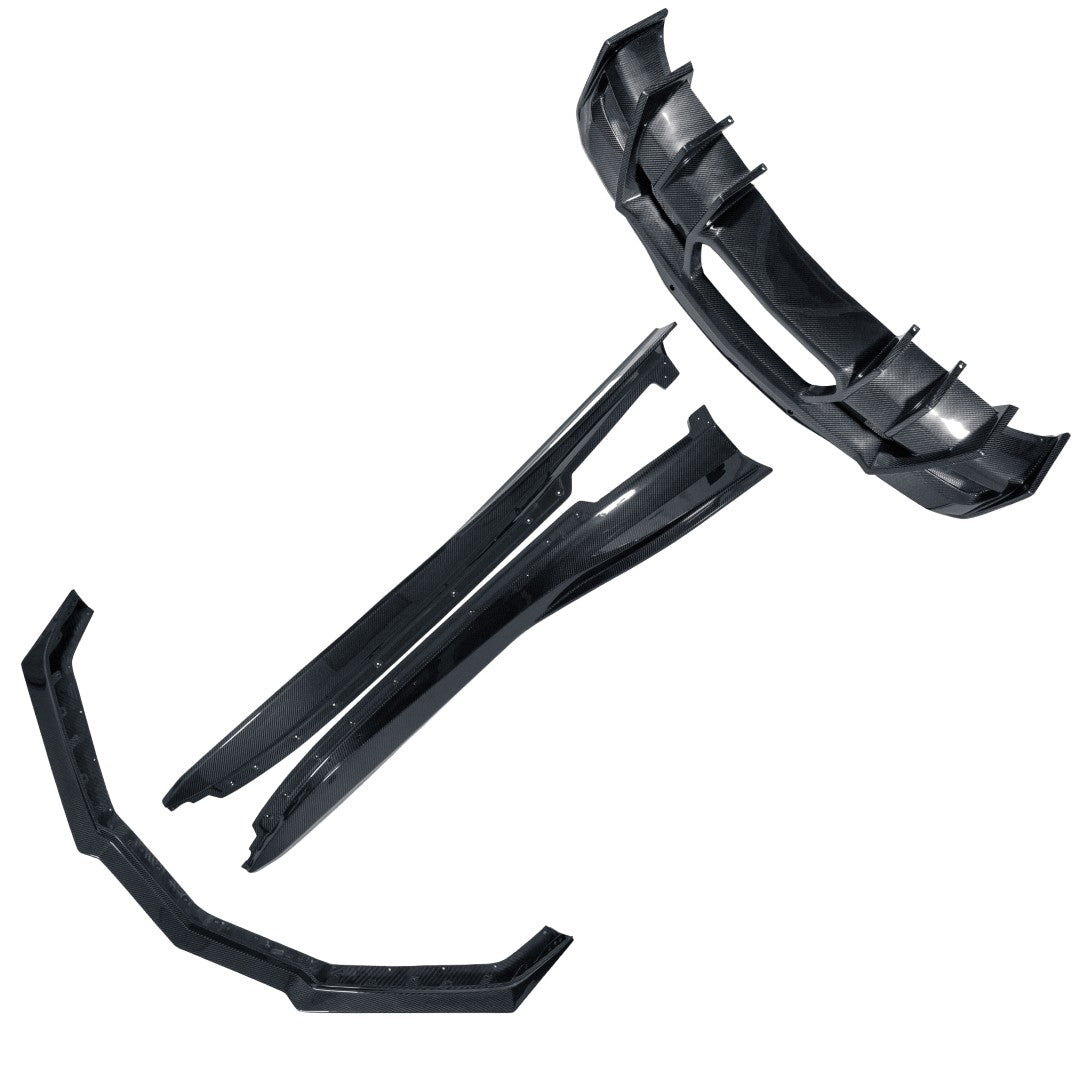
Carbon fiber upgrades are the fastest way to make a car look like it means business. They also shave pounds, add a bit of downforce and make your buddies at the cars and coffee meet ask what you did to it. At Merrick Motorsports, we sell carbon fiber parts for Challengers, Chargers, Corvettes and more, and we know a good aero piece from a sticker on a bumper. This guide walks through which carbon fiber upgrades earn their keep and which ones just look good in a photo.
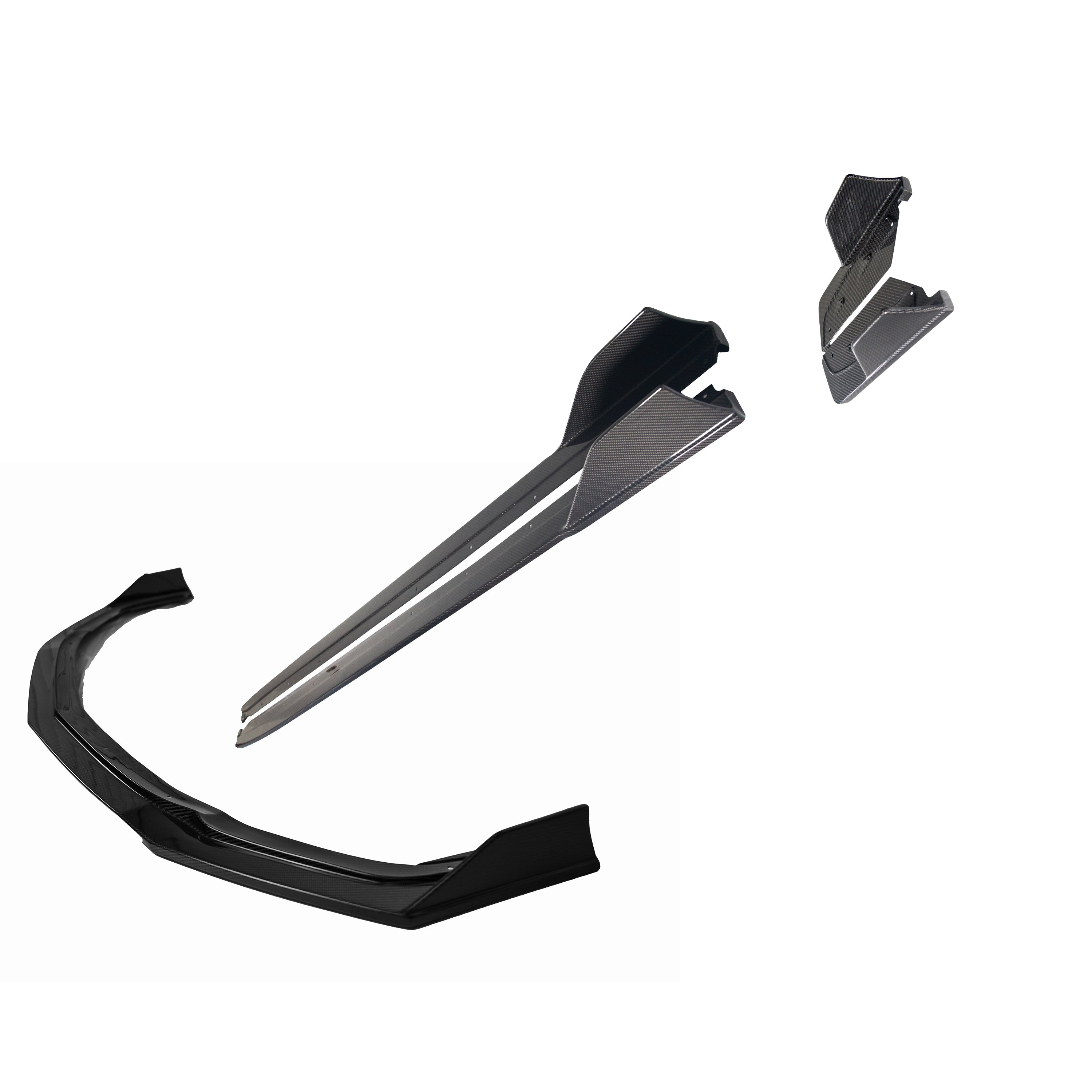
Quick Picks:
- Best Full Upgrade: Carbon Fiber Aero Kits, for owners who want the whole package working together
- Best Bang for the Buck: Front Air Dams, for a visible front-end upgrade with real downforce benefits
- Best for Track Days: The GTC-500 Adjustable Wing, for owners who want tunable rear downforce
Why Carbon Fiber? The Looks, the Weight and the Real Story
Carbon fiber is a material made of thin strands of carbon woven into a sheet and bonded with resin. It is lighter than steel and aluminum and stiff enough to hold its shape under load. That combination is why race teams and high-end builders reach for it first.
The market reflects that appeal, and growth like that means more shops, more parts and more choices. It also means more junk, so knowing what to buy matters.
Here is the honest story. Carbon fiber looks fantastic, saves weight and can improve aero when the part is engineered for the car. It is not magic. A carbon-look sheet of plastic on a bumper adds little beyond style. Our Merrick Motorsports aero parts are made from pre-preg carbon fiber cured in an autoclave, which is the process that delivers the strength and rigidity you're paying for. Confirm which hood fits your exact model before you order by checking the Dodge Charger carbon fiber hood fitment guide.
How Carbon Fiber Improves Your Car's Look and Stance
Nothing sells a car's attitude like the weave. Under a clear coat, a well-laid carbon pattern gives a front splitter or hood a racy depth. Pair it with a lower stance and a visible aero piece and the whole car reads as purpose-built.
Look is subjective, though. Some enthusiasts find carbon too busy or too race-inspired for a street car, and that is a fair call. If you want a subtle upgrade, a single carbon piece like a rear diffuser or side rocker extensions does more quietly than a full aggressive kit. Pick the level of attitude you actually want to drive around with every day.
Stance comes from fitment. A part that sits flush with the body lines looks like it came from the factory. Our aero parts are vehicle-specific, designed for precise fitment.
Weight Savings and the Strength-to-Weight Ratio Explained
Let's talk about the number every carbon fiber ad waves around: weight. Carbon fiber is light, and it's strong. But if you don't understand why that matters and where it matters, you're just buying expensive confetti. Here's the garage-talk version.
Strength-to-weight ratio is simple math: how much load a material can carry divided by how much it weighs. Carbon fiber composites can beat steel and aluminum on that ratio because the carbon strands do the load-bearing work while the resin holds them in place. Think of it like a well-built roll cage versus a solid block of metal, same job, way less mass.
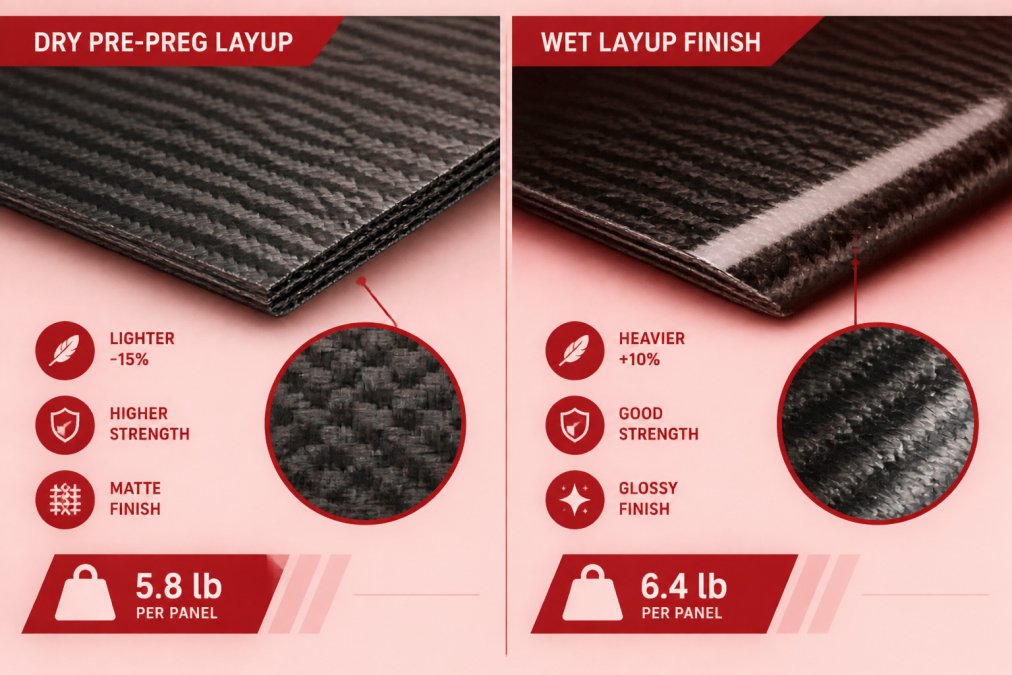
The process matters more than the brochure. Dry carbon (pre-preg) is laid up with a precise resin content and cured under heat and pressure, usually in an autoclave. Wet-layup carbon is hand-laid with resin mixed at the bench. Dry carbon parts are generally lighter than wet-layup versions of the same shape, though the difference depends on the part and the builder. Ask your seller which process they use.
Where the weight comes off matters more than the total. On a street car, dropping a few pounds from the nose, hood, front splitter, air dam, changes how the front end reacts in transitions more than shaving the same weight from the trunk. Why? Because reducing mass at the ends lowers the polar moment of inertia, which is a fancy way of saying the car rotates more eagerly. A carbon hood and front lip combo is a classic dad-garage upgrade for exactly that reason.
Watch out: don't assume a carbon part is automatically lighter than the factory piece. Ask for the actual part weight before you buy.
Shop carbon fiber hoods and front-end parts here: Carbon Fiber Hoods and Front End Parts
A quick reality check: weight savings alone won't turn a commuter into a track car. Combining a lighter front end with a proper splitter is a way to change how the front end feels without touching the engine. That's the kind of upgrade a guy can justify to his wife as "safety and handling." You're welcome.
Aero Kits, Splitters and Wings: Ranking the Upgrades That Matter
Aero is where carbon fiber parts come into play. Downforce pushes the tires into the pavement, which helps grip at speed. Drag is the cost of that grip. A good aero upgrade balances the two for how you actually drive.
Our ranking, from the biggest commitment to the smallest:
- Full aero kits for owners who want the complete system.
- Front air dams and splitters for the most visible front-end gain.
- Adjustable wings for tunable rear downforce.
Full Aero Kits for Track-Minded Owners
A full kit works as a system. Our Carbon Fiber Aero Kit for the Chevrolet Corvette C8 Z06, E Ray, ZR1 and Grand Sport ($6,500.00) combines a front air dam, side rocker extensions and a rear diffuser to manage airflow around and under the car. The kit includes integrated metal skid plates on the front air dam and a UV-resistant clear coat, plus the mounting hardware needed for installation.
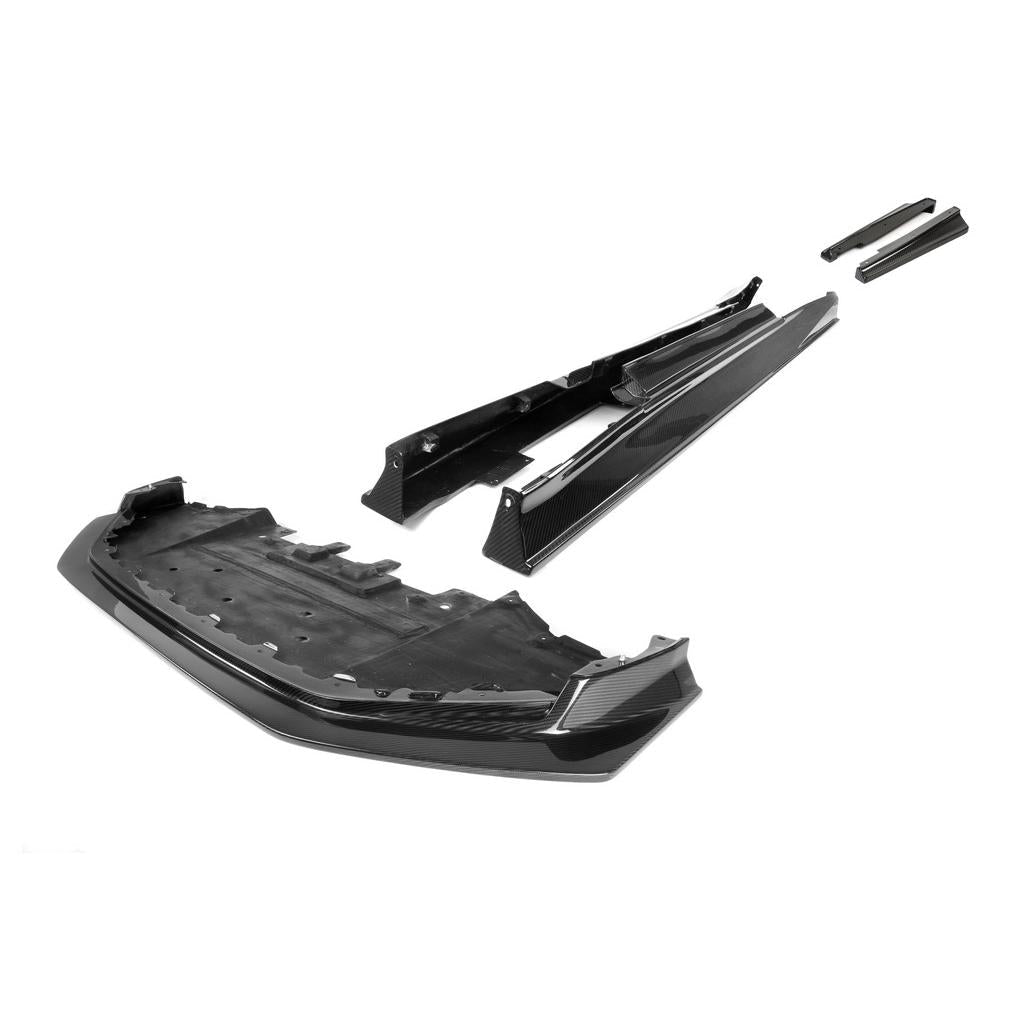
Shop the full Corvette C8 Z06 aero kit here: Carbon Fiber Aero Kit - Chevrolet Corvette C8 Z06/ E Ray/ ZR1/ Grand Sport
If you're running a Nissan R35 GT-R, the Carbon Fiber Aero Kit for the 2017-2022 model ($5,222.00) follows the same system approach. For Acura DE5 Integra Type S owners, the Carbon Fiber Aero Kit ($3,546.00) covers the full package.
Best for: owners planning serious track time who want front and rear balance. Skip if: your car sees mostly daily commuting and you only want a visual upgrade.
Full kits are a big investment. Buy one when you know you'll use the downforce. For a car that lives on the street, a single front piece often gives you most of the look for less money.
Front Air Dams and Splitters for Downforce
The front air dam is a quick way to change how a car looks. It is designed to reduce front-end lift and support steering response at speed.
Our Chevrolet Corvette C7/ C7 Z06 Carbon Fiber Front Airdam/ Lip ($1,280.00) and the Corvette C8 Stingray Carbon Fiber Front Splitter, Airdam, Lip ($1,485.00) both include integrated metal skid plates. Challenger owners looking for a front splitter can browse Challenger Hellcat front airdam options. Those plates matter. The skid plates are designed to help protect the carbon fiber from minor scrapes, driveway contact and road debris.
Check the fit note before ordering. The C8 Stingray splitter only fits Stingray models.
Best for: anyone wanting a visible front upgrade with a real aero reason behind it. Skip if: you have a low front bumper and no plan for careful driving, since any lip can scrape.
Adjustable Wings for Tunable Rear Downforce
The GTC-500 Adjustable Wing is designed for owners who want to tune their rear downforce. It has a fully adjustable angle of attack from 0 to 15 degrees, so you can run more grip in tight corners and less drag on the straights.
We carry GTC-500 wings for the Corvette C8 ($3,580.00), C7 ($3,373.00), C6 and C6 Z06 ($2,471.00), and the C7 Z06/Grand Sport chassis-mount version ($5,153.00). That last one includes chassis mount reinforcement brackets, a carbon fiber rear spoiler delete and an LED third brake light. It does not fit the Stingray.
Two notes that save headaches. The C7 GTC-500 does not fit the convertible. The C6 version is made to order with a 1 to 2 week lead time, while the C7 and C8 versions take 2 to 3 weeks. Plan ahead if you want it before the next event.
Best for: track-day owners and time attack drivers who want tunable rear grip. Skip if: you only drive on the street and never plan to adjust the setup.
Here is how the three main aero upgrades compare at a glance, based on the picks above.
| Upgrade | Best for | Key difference |
|---|---|---|
| Full aero kit | Owners planning serious track time | Front and rear work as one system |
| Front air dam or splitter | Visible front-end upgrade with a real aero reason | Single piece, skid plates included |
| Adjustable wing | Track-day owners wanting tunable rear grip | Angle adjustable from 0 to 15 degrees |
Carbon Fiber Hood with UV Protection: What to Check Before You Buy
A carbon fiber hood is the crown jewel of the garage, the part that makes your buddies ask if it's real. Not all carbon is created equal, and some "carbon fiber" hoods are fiberglass with a carbon look. Before you drop coin, run this checklist like you're inspecting a used car.
1. Dry vs. wet carbon. Dry (pre-preg) carbon is laid up with precise resin content and cured under heat and pressure. Wet-layup is hand-laid with resin mixed at the bench. Dry carbon is the process our aero parts use, cured in an autoclave for strength and rigidity. Ask which process the hood uses. If the seller dodges the question, assume wet-layup and price accordingly.
2. Weave consistency. Look at the pattern. A quality carbon hood has a straight, even weave with no wavy lines, gaps, or patches where the fabric was stretched. Run your hand across it, if you feel ripples under the clear coat, the layup was rushed. A good weave is like a good haircut: you shouldn't see the seams.
3. Resin quality and clear coat. The resin bonds the carbon; the clear coat protects it from UV. Ask for the clear-coat specification and whether it's UV-resistant. Our aero kits and splitters list a UV-resistant clear coat as standard.
4. Genuine carbon vs. cosmetic overlay. This is the big one. A cosmetic overlay is a thin layer of carbon fabric over fiberglass or plastic. It looks the part but adds no real strength and often weighs more than a true carbon part. How to tell? Look at the edges and the underside. Genuine carbon parts typically show a visible carbon structure underneath. Also check the weight.
5. Fitment. A hood that's close is not a hood that fits. Confirm year, make, model, and trim before ordering, and read the listing notes for model limits. A quarter-inch gap at the fender looks like a mistake every time you walk up to the car.
Watch out: don't assume a hood listed as "carbon fiber" is a full carbon part. Check the construction before you buy.
Shop carbon fiber hoods with UV-resistant clear coat here: Carbon Fiber Hoods
Protecting the finish helps your carbon hood look its best for years. Read the practical steps to prevent carbon fiber peeling for the full list of prevention habits. Buy once, cry once, then spend the savings on tires.
How to Protect Carbon Fiber from UV Damage and Peeling
Carbon fiber itself doesn't break down in sunlight. The resin and clear coat over it do, and that's where fading, yellowing and peeling start. Protecting the finish is the job.
Start by buying parts with a UV-resistant clear coat. Then park in the shade when you can, and use a UV-protectant product made for clear coats. Avoid harsh solvents, and wash with a mild car soap. Keep an eye on the edges, since that is where lifting usually begins.
If peeling starts, act early. Catching a small lift early is easier than dealing with one that has spread. Keep your receipt and product information in case you need to talk to the seller about the finish.
Carbon Fiber Car Parts Maintenance: Keeping the Finish Sharp
Carbon looks best when it's clean and cared for. Wash it by hand with a soft mitt, rinse well, and dry it with a microfiber towel to avoid water spots. Hard water leaves mineral spots that bake onto the clear coat if you let them sit in the sun. If spots have already formed, follow the guide on removing water spots from carbon fiber trim to lift them safely.
For the skid plates on front air dams and splitters, check them after every track session or rough driveway trip. Look for scrapes and loose hardware. Check the mounting bolts after the first few drives.
Keep chemicals off the finish. Acetone, strong degreasers and abrasive compounds can dull or damage clear coat. A quality UV-protectant or sealant made for clear coats can help keep the finish looking its best.
Picking Your First Carbon Fiber Upgrade at Merrick Motorsports
Here's how we'd approach it. If you want the most visible change with a real performance benefit, start with a front air dam or splitter for your model. If you're committed to the full look and the track, the complete aero kit makes sense. If you want to tune your rear for events, the GTC-500 is the move.
Whatever you choose, match the part to your exact year, make, model and trim, check the fitment notes, and plan for the lead time on made-to-order pieces. Challenger owners can compare options in the Dodge Challenger carbon fiber interior guide. Our team at Merrick Motorsports ships from six US locations and carries parts for Dodge Challenger, Charger, RAM trucks, Jeeps, Corvettes and Mustangs. Browse the carbon fiber lineup, pick the piece that fits your build, and get your car looking like it means business.
Frequently Asked Questions
What carbon fiber upgrades can improve a car's appearance and performance?
The biggest visual changes come from front air dams, side rocker extensions and rear diffusers, which change the car's stance and profile. On the performance side, a front splitter or air dam adds front-end downforce, and an adjustable wing such as the GTC-500 lets you trade downforce for drag. Merrick Motorsports carries aero kits for the Nissan GT-R, Acura Integra Type S and Corvette C6 through C8, so match the kit to your model and how you drive.
How do you choose durable carbon fiber parts for a vehicle?
Look for pre-preg carbon fiber cured in an autoclave under high temperature and pressure, since that process gives strength and rigidity with less weight. Check that the part is built for your exact year and model. Integrated metal skid plates and a UV-resistant clear coat are useful signs that the maker expected real-world wear. Read the listing for fitment notes before you order, because a part that is marked as a direct fit still may need checking.
Does a carbon fiber hood improve performance?
A hood mainly saves weight and changes the look. Carbon fiber is lighter than steel, and a lighter front end can help handling, but the gain depends on the car and how much stock metal it replaces. Downforce and drag are controlled more by the splitter, air dam and wing than by the hood. If a hood is your next purchase, pick one that fits your model and includes UV protection so the finish lasts.
How do you maintain carbon fiber car parts?
Wash with a mild car soap and a soft mitt, rinse well and dry with a microfiber towel. Avoid harsh solvents and abrasive polish on the clear coat. Once or twice a year, apply a quality UV-protectant or ceramic sealant to keep the finish from fading. Check mounting hardware and skid plates after rough driveways or track days, and fix any chips early so moisture cannot reach the fibers.
