


How to Identify High Quality Carbon Fiber
Last Updated: October 23, 2026
Quick Summary
To identify high quality carbon fiber, inspect the weave pattern under bright light for tight, consistent squares, run your hand over it to feel the texture and weave, check the edges to see layered fibers wrapped in resin, and tap it to hear a crisp sound. Real carbon fiber is rigid, shows depth when light reflects off it, and feels substantial, unlike vinyl wraps or ABS plastic fakes.
- Plain weave looks like a checkerboard and is strong in both directions, while twill weave has diagonal lines and is easier to mold into curves.
- 1K and 3K tow counts are best for cosmetic parts, while 12K and 24K are used for affordable structural components.
- Vinyl wraps feel smooth and slippery with flat light reflection, while real carbon fiber has texture and shows variation in how light bounces off it.
- Check edges carefully: real carbon fiber shows layers of woven fabric in resin, ABS plastic shows solid plastic, and fiberglass feels grainy.
- Carbon fiber is roughly 25% lighter than fiberglass for the same thickness, so if a part feels heavy, it's probably not real carbon fiber.
Table of Contents
- Why Carbon Fiber Quality Matters for Your Build
- Real vs Fake Carbon Fiber: What You're Actually Looking At
- Carbon Fiber Weave Types: Plain, Twill, and What They Tell You
- Step-by-Step Carbon Fiber Quality Inspection Checklist
- Carbon Fiber Automotive Parts Fitment: Ensuring Your Part Actually Fits
- What High-Quality Carbon Fiber Looks and Feels Like
- Common Mistakes When Evaluating Carbon Fiber
- Conclusion: Trust Your Inspection, Not Just the Price Tag
- Frequently Asked Questions
Why Carbon Fiber Quality Matters for Your Build
Real carbon fiber hits different. It's lighter, stronger, and looks like you actually know what you're doing under the hood. But here's the thing: the market is flooded with fakes. Vinyl wraps. ABS plastic pretending to be the real deal. Fiberglass masquerading as motorsport-grade material.
The difference between genuine carbon fiber and cheap imitations isn't subtle once you know what to look for. This guide walks you through exactly how to identify high quality carbon fiber before you buy, install, or waste another dime on parts that won't last.
Real vs Fake Carbon Fiber: What You're Actually Looking At
Let's be clear: not everything shiny and black is carbon fiber. The automotive aftermarket is packed with convincing fakes. Real carbon fiber is woven fabric that's been layered with resin and cured. Fake carbon fiber? That's usually vinyl, plastic, or fiberglass wearing a disguise.
The Vinyl Wrap Scam
Vinyl wraps are the easiest fake to spot once you know what to look for. They're printed with a carbon pattern and stuck to ABS plastic or fiberglass underneath. The problem: vinyl peels, fades, and looks flat. Real carbon fiber has depth.
Run your hand over it. Vinyl feels smooth, almost slippery. Genuine carbon fiber has texture. You can feel the weave. The pattern isn't just printed on the surface; it's actually woven into the material.
Look at it from different angles under bright light. Vinyl reflects light evenly, like a sticker. Real carbon fiber shows variation in the weave. Some areas catch light differently based on how the fibers are layered.
ABS Plastic with Carbon Print
This is the middle-ground fake. Manufacturers take ABS plastic, print a carbon pattern on it, and coat it with clear plastic. It looks decent from ten feet away. Up close? It falls apart.
ABS plastic is brittle and flexes too much. Real carbon fiber is rigid. If you press on an ABS part, it gives. Press on genuine carbon fiber and it barely moves. That's because carbon fiber is actually load-bearing. ABS is just cosmetic.
The edges are the giveaway. Cut or break ABS and you see solid plastic underneath. Real carbon fiber shows layers, the woven fabric wrapped in resin. The weave pattern runs all the way through, not just on the surface.
Fiberglass Imposters
Fiberglass is cheaper than carbon fiber and easier to manufacture. Some sellers pass it off as carbon fiber because people don't know the difference. Fiberglass is made from glass fibers, not carbon. It's heavier, weaker, and yellows over time.
Fiberglass feels grainy. Carbon fiber feels smooth but textured. Fiberglass is also more flexible, bend it and it might not spring back. Carbon fiber bends and returns to shape because it's stiffer.
Weight is another clue. Pick up a fiberglass part and a carbon fiber part of the same size. Carbon fiber wins every time. It's roughly 25% lighter than fiberglass for the same thickness. If a "carbon fiber" part feels heavy, it's probably not carbon fiber.
Carbon Fiber Weave Types: Plain, Twill, and What They Tell You
Not all carbon fiber weave patterns are created equal. The weave tells you about the part's strength, flexibility, and how it was manufactured. Understanding weave types is half the battle in identifying high quality carbon fiber.
Plain Weave vs Twill Weave
Plain weave is simple: one fiber goes over, one goes under, repeating in a grid pattern. It looks like a checkerboard. Plain weave is strong in both directions but can be harder to work with during manufacturing. It's also stiffer and less forgiving on curves.
Twill weave is more complex: fibers go over two, under one, creating diagonal lines. Twill looks more refined and is easier to mold into curves. It's also slightly more flexible without sacrificing strength.
When you're looking at a carbon fiber part, check the weave pattern. Plain weave? Nothing wrong with that, it's strong and reliable. But twill weave usually means the manufacturer invested in better materials and more careful production.
Look at the consistency of the weave. Is every square the same size? Does the pattern run straight? Sloppy weave work means rushed production. High quality carbon fiber has tight, even, consistent weave patterns.
Tow Count and What 1K, 3K, 12K Really Mean
Tow count is the number of carbon filaments bundled together. The numbers, 1K, 3K, 12K, 24K, represent thousands of filaments per bundle.
1K carbon fiber has 1,000 filaments per bundle. It's thinner, more flexible, and takes longer to weave.
3K carbon fiber is the sweet spot for most automotive applications. It's 3,000 filaments per bundle. It's strong, looks good, and is easier to manufacture than 1K. Most quality aftermarket parts use 3K.
12K and 24K have thicker bundles. They're faster to weave and cheaper to produce, but the weave pattern looks coarser. The individual fiber bundles are more visible.
For body panels and cosmetic parts, you want 1K or 3K. For structural parts that need to be affordable, 12K works fine. Higher tow count doesn't automatically mean lower quality, it just means different priorities.
Understanding these weave patterns and fiber counts helps you spot quality manufacturing at a glance.
| Weave Type | Appearance | Best For | Key Difference |
|---|---|---|---|
| Plain Weave | Checkerboard grid pattern | Structural strength | Strong both directions, stiffer |
| Twill Weave | Diagonal lines | High-end body panels | More flexible, easier to mold |
| 1K Tow Count | Thin, refined weave | Premium cosmetic parts | Expensive, requires more labor |
| 3K Tow Count | Medium, balanced weave | Most automotive applications | Sweet spot for strength and looks |
| 12K Tow Count | Coarse, visible bundles | Affordable structural parts | Faster to weave, cheaper to produce |
| 24K Tow Count | Very coarse weave | Cost-efficient components | Thickest bundles, most economical |
Step-by-Step Carbon Fiber Quality Inspection Checklist
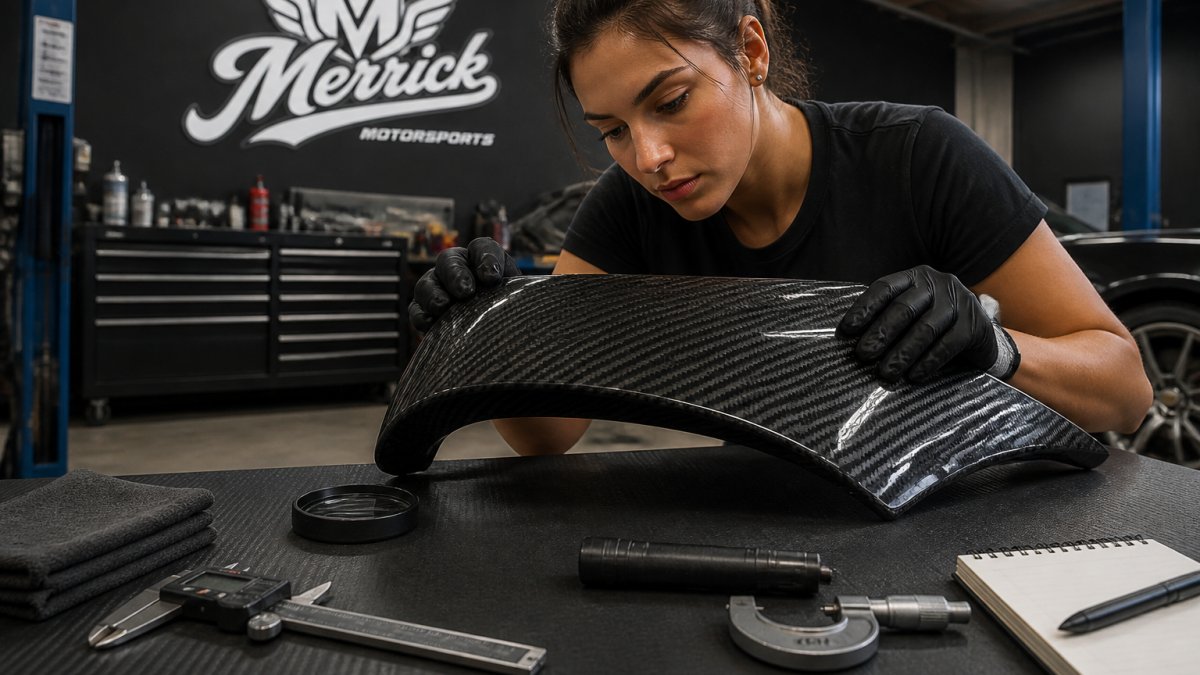
Here's how to actually inspect a carbon fiber part before you buy. This isn't complicated, and it doesn't require special tools. Just your eyes, hands, and light. But before we start, a word of caution: do not burn, sand, cut, or drill a part to test it. Those destructive tests can release hazardous fibers and fumes, damage the part, and give misleading results. Keep it non-destructive and safe.
Step 1: The Visual Inspection
Start with the weave pattern. Look at it under bright light, natural light is best. The weave should be tight and consistent. Every square should be roughly the same size. The pattern should run straight, not wavy or distorted.
Look for imperfections:
- Air bubbles or voids in the resin
- Wrinkles or creases in the weave
- Discoloration or yellowing
- Visible seams or repairs
- Uneven coverage where the weave shows through
Any of these are red flags. They indicate rushed production or poor quality control. But here's the thing: a perfect-looking weave doesn't guarantee structural quality. Real carbon fiber can look great and still have hidden problems like delamination or voids. So use this as a starting point, not the final word.
Step 2: The Texture and Depth Test
Run your hand over the part. Real carbon fiber has texture, you can feel the individual weave squares. Fake vinyl feels smooth and slippery. Cheap ABS feels plasticky.
Press gently on the part. Does it flex? A little flex is normal, but excessive give means it's not real carbon fiber. Real carbon fiber is rigid. It doesn't move around.
Look at the depth of the weave. You should be able to see down into the weave pattern, not just see it printed on the surface. This is the difference between woven carbon fiber and a vinyl wrap.
Step 3: The Light Reflection Check
Shine a light on the part at different angles. Real carbon fiber shows variation in how light reflects off it. Some areas catch light brighter, some darker, depending on the weave direction and the resin thickness.
Vinyl wraps reflect light evenly, like looking at a sticker. The reflection is uniform and flat. Real carbon fiber has depth to that reflection.
Tilt the part side to side. Does the reflection change as you move it? That's a good sign. The weave is actually there, and light is bouncing off it differently depending on the angle.
Step 4: The Edge Inspection
This is the most telling test. Look at the edges of the part. If it's been cut or has a natural edge, you can see what's underneath.
Real carbon fiber edges show layers, the woven fabric wrapped in resin. Check out a real product example with genuine carbon fiber versus fiberglass alternatives to see the difference firsthand. You see the individual fibers. The edge is consistent all the way through.
Fake edges tell the story:
- Solid plastic underneath = ABS plastic
- Grainy texture = Fiberglass
- Smooth plastic layer = Vinyl wrap over plastic
If the edge is sealed or hidden, ask the seller why. Legitimate manufacturers aren't hiding their edges.
Step 5: The Sound Test
Tap the part gently with your knuckle. Real carbon fiber has a distinctive sound, a sharp, crisp tap. It sounds like tapping on a rigid material.
ABS plastic sounds dull and hollow. Fiberglass sounds similar but slightly different, more like tapping on thick plastic. Vinyl wrapped parts sound like tapping on plastic because that's what's underneath.
2022-2026 Subaru BRZ / Toyota GR86 Real Carbon Fiber Front Lip →
This isn't foolproof, but combined with the other tests, it adds to the picture.
Step 6: Structural Quality Checks (The Part Competitors Skip)
Looks can be deceiving. A part can pass every visual test and still be a structural dud.
Resin condition: Look for a smooth, even clear coat. Bubbles, cloudy patches, or tacky spots mean poor resin curing.
Delamination: This is when layers of carbon fiber separate. Look for whitish or cloudy areas near edges or mounting holes.
Voids: These are empty spaces in the resin. They look like tiny air bubbles trapped under the surface.
Fiber alignment: The fibers should run in straight, parallel lines within each tow. Wavy or crooked fibers mean poor layup and reduced strength.
Workmanship: Check mounting holes for clean drilling. Rough edges or splintered holes concentrate stress and can lead to cracks.
Remember: these checks are for structural parts like hoods, fenders, or chassis components. For cosmetic trim, visual authenticity is usually enough.
Carbon Fiber Automotive Parts Fitment: Ensuring Your Part Actually Fits
You found a part that looks like high quality carbon fiber. Great. Now make sure it actually fits your vehicle. A perfect-looking part that doesn't fit is worthless.
Check Compatibility Before Ordering
Know your vehicle's year, make, model, and trim. Carbon fiber parts are often trim-specific. A part designed for a 2023 Dodge Challenger won't fit a 2020 model. The mounting points are different.
Check the product description carefully. It should list exact fitment years and trims. If it says "fits most models" or "universal fit," that's a red flag. Carbon fiber body parts aren't universal.
Inspect the Mounting Points
Before installation, inspect where the part connects to your vehicle. Look at the mounting points on your car. Are they clean? Free of damage?
Check the mounting points on the carbon fiber part. They should be reinforced, thicker resin around the mounting area. This prevents stress cracks when you tighten the bolts.
The mounting holes should be clean and well-drilled. Sloppy holes or rough edges mean poor manufacturing. Stress will concentrate there and the part could fail.
Some carbon fiber parts come with mounting hardware included. Learn how to properly install a carbon fiber part after verifying its quality and fitment. That's a sign of quality. The manufacturer designed the part with installation in mind, not as an afterthought.
What High-Quality Carbon Fiber Looks and Feels Like
After you've done the inspection tests, you should have a clear picture. Real high-quality carbon fiber has specific characteristics. Memorize them.
It looks refined. The weave is tight and consistent. The pattern is clear and straight. There are no visible imperfections, air bubbles, or discoloration.
It feels substantial. Pick it up. It's light, but it doesn't feel fragile. It's rigid and doesn't flex excessively. When you press on it, it barely moves. The edges are smooth and well-finished.
It sounds right. Tap it and it makes a crisp, sharp sound. Not dull. Not hollow. The sound is consistent across the whole part.
It reflects light intelligently. The reflection changes as you move the part. The weave pattern shows depth. Light bounces off it in a way that shows the material's complexity, not a flat surface.
Compare this to vinyl wraps and cheap ABS. The difference is obvious once you know what to look for.
Cosmetic Trim vs. Load-Bearing Parts: Different Standards
Not all carbon fiber parts are created equal, and they shouldn't be judged the same way. Cosmetic parts, like dash trim, mirror caps, or engine covers, are mostly about looks. For these, visual authenticity and a good clear coat are the main things. If it looks real and feels rigid, you're probably fine.
Load-bearing parts, like hoods, fenders, splitters, or chassis braces, need more. You can explore interior carbon fiber applications and fitment considerations beyond just exterior parts. Here, structural integrity is critical. You need to check for delamination, voids, fiber alignment, and proper resin curing. A cosmetic part with a few small voids might be acceptable; a load-bearing part with the same voids could fail under stress.
So before you buy, ask yourself: is this part just for show, or is it doing real work? That answer determines how deep your inspection should go.
Documentation and Traceability: The Paper Trail of Quality
High-quality carbon fiber often comes with paperwork. Not always, but it's a good sign. Look for material certificates that specify the fiber type (like 3K twill), resin system, and manufacturing process. Batch records can trace the part back to its production run. A solid warranty also indicates the manufacturer stands behind their product.
If a seller can't provide any documentation, be cautious, especially for load-bearing parts. Reputable manufacturers are proud of their materials and happy to share the details.
At the end of the day, high-quality carbon fiber should look good, feel rigid, and, if it's structural, be backed by evidence of good manufacturing. Don't just trust your eyes; trust the paperwork and the reputation of the seller.
Common Mistakes When Evaluating Carbon Fiber
People make the same mistakes over and over when trying to identify high quality carbon fiber. Don't be one of them.
Mistake 1: Trusting the price alone. Cheap doesn't mean fake, and expensive doesn't mean real. Price is one factor, but it's not the whole story.
Mistake 2: Assuming all shiny black parts are carbon fiber. Vinyl wraps are shiny. ABS plastic is shiny. Fiberglass is shiny. Shiny doesn't equal carbon fiber.
Mistake 3: Not checking the weave pattern carefully enough. Spend time looking at the weave under good light. This is where the truth lives.
Mistake 4: Ignoring the edges. The edges don't lie. If you can see them, look at them carefully.
Mistake 5: Buying without verifying fitment. A beautiful part that doesn't fit is a waste of money and frustration. Verify compatibility before you order.
Mistake 6: Assuming heavier is stronger. Carbon fiber is strong because of its material properties, not its weight.
Conclusion: Trust Your Inspection, Not Just the Price Tag
You now know how to identify high quality carbon fiber. You know the difference between real weave and vinyl wraps. You understand tow counts and weave patterns. You can inspect a part and know whether it's the real deal.
The market is full of convincing fakes. But armed with these inspection techniques, you won't get burned. Real carbon fiber has specific characteristics, the weave, the texture, the reflection, the sound, the edges. Check all of them before you buy.
When you're ready to upgrade your Challenger, Charger, RAM, or other ride, Merrick Motorsports has genuine carbon fiber parts that pass every inspection test. We stock quality components that look as good as they perform.
Frequently Asked Questions
How can you tell real carbon fiber from a printed pattern?
Real carbon fiber has visible depth and texture in the weave, you can see individual fiber strands and feel the three-dimensional surface. A printed pattern is flat; it looks like a photo glued to plastic. Run your finger across genuine carbon fiber and you'll feel the weave's raised pattern. Printed vinyl feels smooth and uniform. Real carbon fiber also shows consistent weave structure from every angle, while prints flatten out when viewed from the side.
What does high-quality carbon fiber look like?
High-quality carbon fiber displays a uniform, consistent weave pattern with no gaps, wrinkles, or voids in the material. The surface should have a wet, glossy appearance from the clear coat, and the fibers should lie flat without bubbling or separation. The edges should show clean, tightly woven fibers, not fraying or splintering. A quality part like the Subaru BRZ carbon fiber front lip has a crisp weave pattern, flush fitment with factory components, and no imperfections in the resin finish.
Does a visible carbon fiber weave mean a part is made entirely of carbon fiber?
Not necessarily. Some parts use carbon fiber as a top layer over fiberglass or ABS plastic for cost savings. Inspect the cut edges and mounting areas, these reveal what's underneath. Genuine, all-carbon-fiber parts show consistent carbon weave all the way through. If you see fiberglass cloth or plastic substrate at the edges, you're looking at a hybrid or composite part, which may still be quality but isn't pure carbon fiber. Check the product description and ask the seller about construction before buying.
Is carbon fiber safe to touch?
Yes, carbon fiber itself is safe to handle. However, take care with sharp edges or cut fibers, which can splinter like fiberglass. Wear gloves if you're handling unfinished or freshly cut carbon fiber parts to avoid irritation. Once a part is finished with clear coat and properly sealed, like Merrick Motorsports' carbon fiber components, it's completely safe for everyday contact. Just avoid dragging your skin across raw, unfinished edges.
Get your carbon fiber upgrades from Merrick Motorsports. We carry over 30,000 aftermarket parts shipped from six locations across the US, with fitment that's guaranteed to work on your specific vehicle. Start shopping for parts that actually deliver on the promise.
