


9 Dodge Charger Parts Worth Bolting On (Car Guy Picks)
Quick Summary
The best dodge charger parts to bolt on first are brakes, a cold air intake, a cat-back exhaust, LED side markers, and an aluminum expansion tank. Go aftermarket for airflow, braking, sound, and looks, and stay close to OE for wear items. Always confirm fitment against your exact year, trim, and engine before ordering.
- Upgrade brakes before adding horsepower so stopping power keeps pace with go power.
- Pair a cold air intake with a cat-back exhaust so airflow in and out stays balanced.
- Confirm CARB status on any performance intake before buying for a California vehicle.
- Verify year, trim, engine, and body style against the fitment table before you order.
- Plug-and-play LED side markers and the expansion tank are the easiest installs on the list.
Table of Contents
- Why Your Charger Deserves Better Than Factory Stock Parts
- Quick Comparison: 9 Charger Parts at a Glance
- 1. Best Cold Air Intake for Dodge Charger 5.7 HEMI
- 2. Flowmaster FlowFX Cat-Back Exhaust for Hellcat and SRT Chargers
- 3. Brembo Front and Rear Brake Upgrades Built to OE Spec
- 4. Raxiom Axial LED Side Markers for a Cleaner Look
- 5. Mishimoto Aluminum Expansion Tank for the Engine Bay
- 6. Quick-Release Front License Plate Bracket for a Clean Nose
- Dodge Charger OEM vs Aftermarket Parts: How to Choose
- Dodge Charger Performance Upgrades: Build Smarter, Not Just Faster
- Frequently Asked Questions
Before the shop lights come on, here's the lineup for this one: nine Dodge Charger parts worth bolting on, with a few garage-tested opinions thrown in for good measure.
Welcome to the garage. Grab a coffee, pop the hood, and let's talk about making your Charger look and run the way it deserves. Dodge built a good car, but factory stock is a starting point, not a finish line. Here's our take on where your Charger's upgrade dollars should go first.
Why Your Charger Deserves Better Than Factory Stock Parts
Factory parts are built to meet a price point, a warranty, and a broad audience. That's fine for the daily commute. It's less fine when you want your car to sound like it means it, breathe like it means it, and look like it means it. Upgrades have to fit right, though. A part that says "direct bolt-on" on the box doesn't always bolt on perfectly, and a little fitment homework saves a lot of cussing later.
So we're focusing on parts that do real work: airflow, braking, sound, lighting, and the small pieces that make the nose and engine bay look finished. Pick the ones that match your car's year, trim, and engine, and you'll be happy you did.
Quick Comparison: 9 Charger Parts at a Glance
| Part | Area | Best For | Installation |
|---|---|---|---|
| Cold air intake | Engine | HEMI owners wanting more airflow | Moderate |
| Cat-back exhaust | Exhaust | Hellcat and SRT sound upgrades | Moderate |
| Brake rotors and pads | Braking | Stopping power with OE-level fit | Moderate |
| LED side markers | Lighting | Cleaner, brighter exterior look | Easy plug-and-play |
| Expansion tank | Cooling | Tidying up the engine bay | Easy |
| License plate bracket | Exterior | A clean nose without drilling | Easy |
1. Best Cold Air Intake for Dodge Charger 5.7 HEMI
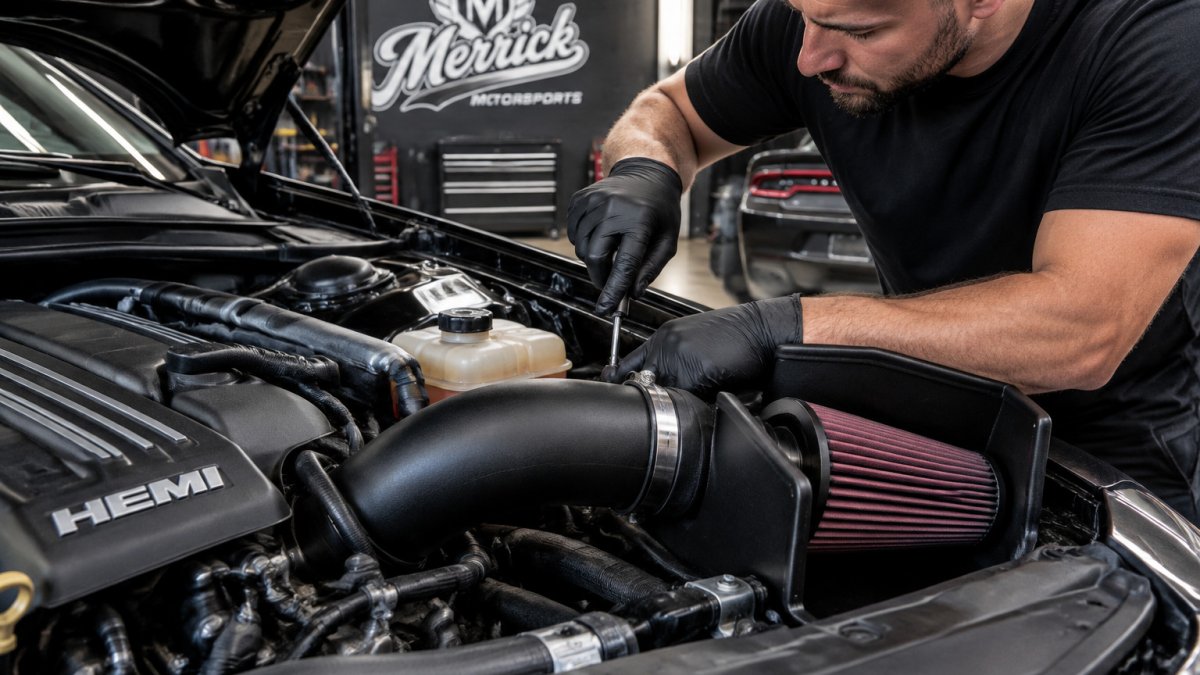
A cold air intake is one of the first things most owners reach for, and for good reason. It gives the engine a larger volume of air to work with, and K&N intakes are built around a high-density polyethylene tube paired with a washable, reusable high-flow filter. The filter is oiled cotton media, and the oversized conical design is listed for up to 100,000 miles between filter services under normal highway driving conditions. A custom heat shield keeps intake air away from the hot engine bay, which matters on a summer afternoon.
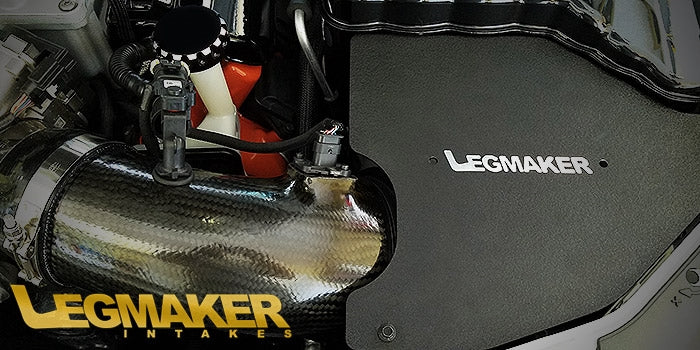
Check the fitment table before you order, because the same K&N family covers several Mopar platforms with different part numbers. For a 2011-2014 Charger 3.6L V6, the K&N 57-1564 performance intake is the listed fit. Some intakes are not legal for sale or use on pollution-controlled vehicles in California, so check the CARB status on the specific part for your vehicle.
Best for: owners who want a simple, reusable filter and a clean engine bay look. Skip if: you need a specific CARB-compliant part and haven't confirmed your state's rules.
Think of it like a rig where every link needs to be the same strength.
2. Flowmaster FlowFX Cat-Back Exhaust for Hellcat and SRT Chargers
If you want your Charger to announce itself before it turns the corner, the Flowmaster FlowFX cat-back system is built for it. It fits the 2015-2023 Dodge Charger Hellcat and SRT models with the 6.2L or 6.4L HEMI and factory active exhaust valves. The system uses mandrel-bent 3.00-inch stainless steel tubing into a Scavenger Series X-pipe, flowing into a pair of Flow FX straight-through mufflers.
The listing describes the sound as moderately aggressive for exterior and interior levels. The large 4.50-inch black ceramic-coated tips sit inside the rear bumper valance, which is a clean look. The system reuses the factory hanger locations and comes with hardware and instructions for a fairly approachable home install.
Watch out: the active exhaust valves are part of the factory setup, so keep them in mind when you're planning the install and check the fit against your exact model year before you order.
3. Brembo Front and Rear Brake Upgrades Built to OE Spec
Brembo's front premium UV-coated rotor and NAO ceramic pads are designed to match or exceed OE specifications for fit and function. The rotors use premium cast iron formulations, and the UV coating protects the rotor surface, including internal ventilation chambers, against corrosion. The listing describes Brembo's Pillar Venting Technology as increasing airflow through the rotor.
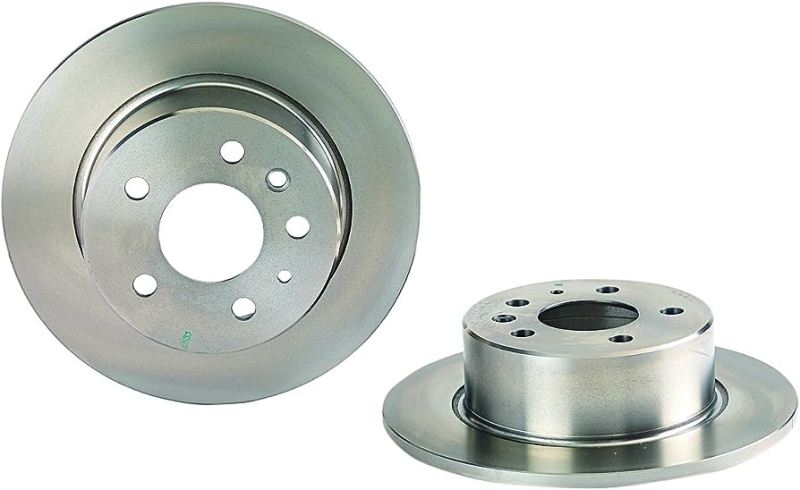
The NAO ceramic pads use chamfered, slotted edges and multi-layer anti-noise shims. For the front, the premium rotor is listed for the 2006-2020 Charger and related Mopar applications, and the front NAO pad fits 2014-2023 Chargers. Rear NAO pads are listed for many 2006-2020 Charger applications. Always confirm the part number against your year and trim, since the fitment lists are long and specific.
Skip if: you're chasing track-day pad compounds, since these are OE-equivalent street pads.
4. Raxiom Axial LED Side Markers for a Cleaner Look
Side markers are a small detail that changes the whole profile of the car. The Raxiom Axial smoked LED side markers replace the factory incandescent units with a sharp LED strip. The housings are injection-molded ABS with smoked polycarbonate lenses, and the red rear and amber front LEDs are weather sealed.
The plug-and-play design is listed as a direct upgrade for the factory lights. Pop out the factory markers, unplug the harness, plug it into the new unit, and snap it in. No cutting, splicing, or resistors. The listing covers many 2015-2023 Charger trims, but double-check your model year and whether you have a widebody, since the listing excludes widebody cars.
5. Mishimoto Aluminum Expansion Tank for the Engine Bay
Let's be honest: the stock expansion tank looks like a yellow lunchbox sitting in a showroom. The Mishimoto aluminum expansion tank swaps that out for a TIG-welded aluminum unit with a cold-fill line built into the internal baffling. It's available in micro-wrinkle black or natural finish, and it's a good choice if you want the engine bay to look like someone cared.
Mishimoto lists this tank for 2011-2023 Dodge Charger, Challenger, and Chrysler 300C applications. Confirm your fit against the listing, since model-year coverage varies across the Charger, Challenger, and 300 lineup.
6. Quick-Release Front License Plate Bracket for a Clean Nose
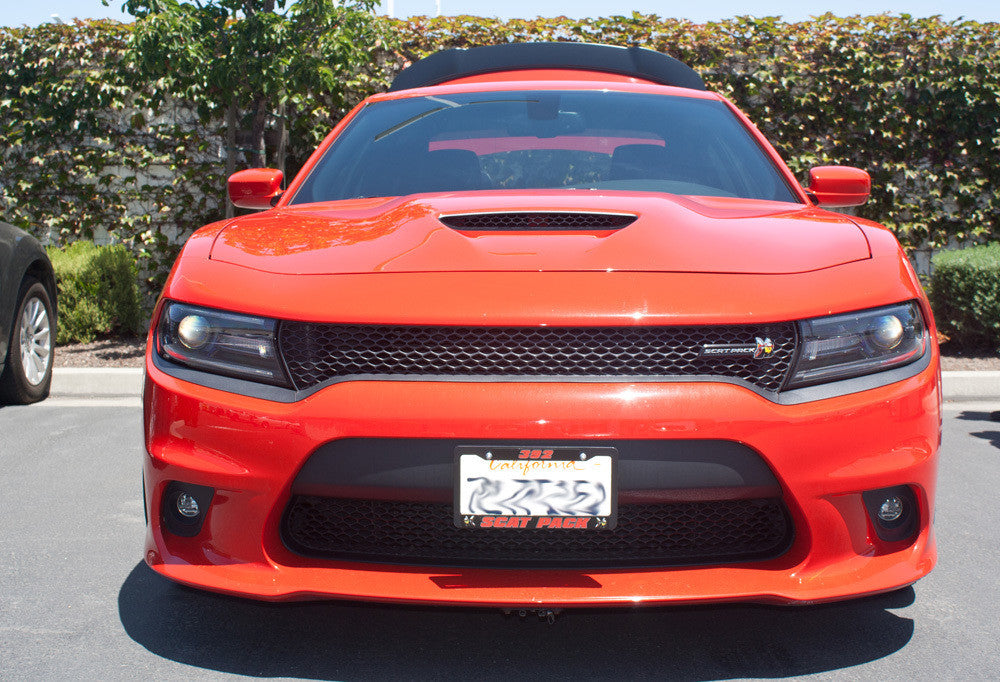
This one is for the owner who loves a clean front bumper but still needs to follow the rules. The STO N SHO quick-release bracket from Big Mike's Performance Parts is a two-piece design. The base plate mounts without drilling into the front of the bumper, and the holder lets you remove the plate in seconds when you want the nose unobstructed. It's made in the USA from 5052 and 6061 aluminum, welded and anodized black, with a limited lifetime warranty.
Fitment is specific. This version is listed for 2015-2018 Charger Hellcat, Scat Pack, and SRT models, the 2017-2018 Daytona, and 2015-2018 GT models with the performance front end. Tools are required for install, and the bracket may look slightly different from the photo depending on model. Make sure you're shopping the right listing for your car.
Watch out: a quick-release plate is still a plate, so check your state's requirements for front plates before you take it off for photos.
Dodge Charger OEM vs Aftermarket Parts: How to Choose
This is the fork in the road where a lot of Charger owners either save money or donate it to the parts gods. Factory parts are engineered to a known spec and are the safe call when you want a repair that looks and behaves like it rolled off the line. For a broader comparison, read The Ultimate Guide to American Made Dodge Performance Parts. The trick is knowing which job belongs in which bucket before you click "add to cart."
Here's the garage-floor version of the decision tree.
Stay close to OE when:
- You're replacing a wear item where the original spec is already the best answer, brake hardware, sensors, mounts, and cooling components that just need to work.
- The car is under a factory warranty and you want zero arguments at the service counter.
- You're chasing a clean, stock-like repair and resale value matters more than attitude.
Go aftermarket when:
- You want a measurable change in airflow, braking, sound, or looks, the categories covered in the picks above.
- You're fixing a known weak point, like a plastic expansion tank that has no business living in an engine bay that runs this hot.
- You want serviceable, rebuildable parts, a washable high-flow filter you can clean instead of replace is a good example.
The fitment homework nobody skips twice. The single biggest difference between a happy install and a weekend of cussing is verifying the part against your exact car. Year, trim, engine, and body style all matter on the Charger, and the same part family often carries different part numbers across those combinations. A 2011-2014 3.6L V6 car and a 2015-2023 Hellcat are not shopping the same shelf, even when the product photo looks identical. Check the fitment table and the part number against your exact year, trim, and engine before you order.
Trim-level reality check. SXT, R/T, Scat Pack, SRT, and Hellcat cars share a silhouette and not much else under the skin. Brake packages, exhaust valve setups, front fascia shapes, and widebody flares all change what bolts on. A part listed as "fits Charger" is a starting point, not a guarantee. The listing's fine print, the model years, the submodels, the widebody exclusions, is where the real answer lives.
Materials and reputation. Read what the part is made of. Then look at the maker's track record and the warranty and return terms listed for the product.
Watch out: a part that says "direct bolt-on" on the box doesn't always bolt on perfectly, and some performance intakes are not legal for sale or use on pollution-controlled vehicles in California, confirm the CARB status on the specific part number for your car before you buy.
The bottom line: buy the part your car actually needs, not the part with the loudest marketing.
Verify CARB status for your specific part number
Dodge Charger Performance Upgrades: Build Smarter, Not Just Faster
Bolt on a random pile of parts and you get a car that fights itself, an intake that outflows an exhaust that can't keep up, or big brakes behind tires that give up first. Do it in order and each upgrade works with the last one instead of against it.
Here's the sequence we'd hand a buddy who just bought his first Charger and wants to do it right.
Step 1: Brakes before horsepower. A front and rear rotor-and-pad refresh built to OE spec gives you confident, quiet street braking without track-day noise. Do this before you add power, because more go with the same whoa is a math problem you don't want to solve in traffic.
Step 2: Airflow in, airflow out. A cold air intake is listed to increase the volume of airflow to the engine, and a cat-back exhaust handles the exit side of the system. Think of it like a rig where every link needs to be the same strength, pairing an intake with a matching throttle body keeps the intake side balanced, and a mandrel-bent stainless cat-back with an X-pipe keeps the exit side flowing. Do them as a pair when you can, because an intake alone on a stock exhaust is a great way to spend money on noise.
Step 3: Cooling and engine-bay tidying. Once the car breathes better, it runs a little hotter and a lot busier. An aluminum expansion tank with internal baffling replaces the stock plastic unit and cleans up the engine bay at the same time.
Step 4: Lighting and detail. LED side markers and a clean front-end setup are the finishing moves. They don't add horsepower, but they change the whole profile of the car, and they're the easiest installs on the list, plug-and-play markers and a no-drill quick-release plate bracket are weekend-morning jobs, not weekend projects.
Installation difficulty, honestly rated. Most of the picks above land in the moderate range: intakes, cat-backs, and brake jobs need basic hand tools, a jack and stands, and some patience with fitment. The easier installs include the side markers, which are plug-and-play, and the expansion tank. The one to plan around is the cat-back on an active-exhaust car, where the factory valves need to be kept in mind during the install. If you're not sure what goes with what, ask before you buy. A few minutes of planning beats a weekend of rework.
How the parts actually change the car. A cold air intake's real job is feeding the engine cooler, denser air and giving you a reusable filter you clean instead of replace. A cat-back's real job is sound and flow, moderately aggressive without the highway drone that wears you down. Knowing what each part is actually for keeps you from buying the wrong one twice.
Watch out: match every part to your exact year, trim, engine, and intended use, and read the fitment notes, some parts need trim-specific mounting or extra hardware, and a widebody car is not shopping the same shelf as a standard-body one.
Build it in order, verify it before you order it, and your Charger will reward you every time you turn the key. That's the kind of math even a dad can do.
Ready to start your build? Browse our full lineup of Dodge Charger performance parts and find the pieces that fit your car. At Merrick Motorsports, we're car people too, and we're happy to help you sort out fitment so your next upgrade bolts on the first time.
Frequently Asked Questions
How much HP does a cold air intake add to a 5.7 Hemi?
Gains vary by setup, engine condition and tuning, so no single number holds for every Charger. Merrick Motorsports lists the K&N 11-14 Dodge Charger 3.6L V6 intake and the K&N 05-08 Magnum/06-10 Charger/08-10 Challenger/05-10 Chrysler 300C Gen II intake among its cold air options. K&N states its HDPE intake tubes are designed to increase airflow, and its listings say installation can typically be completed in under 90 minutes. Check the part's fitment table against your exact year and engine before ordering.
How do I check whether an aftermarket part fits my Dodge Charger?
Start with the year, make, model and submodel, then compare them to the fitment table in the product listing. Fitment tables on Merrick Motorsports listings break down years, trims and submodels, such as the Charger SRT Hellcat or R/T Scat Pack entries on the Flowmaster exhaust. Just because a part says it fits does not mean it fits perfectly, so confirm your trim and engine before you buy.
What is the best cold air intake for a 5.7 Hemi Charger?
The right intake depends on your model year and trim, so match the listing to your exact car. Merrick Motorsports carries K&N cold air intakes whose fitment tables cover many Charger model years and trims, including the Gen II intake that lists 2006-2010 Charger SRT8 and 2006-2019 Charger R/T. Confirm your submodel in the table, then compare the intake's heat shield and filter design against how you drive.
Can aftermarket parts affect a Dodge Charger's warranty?
Aftermarket parts can raise questions about warranty coverage, and the answer depends on the part and the claim. Ask your dealer before installing anything that touches the engine or drivetrain. Merrick Motorsports lists some intakes as not legal for sale or use on pollution-controlled vehicles in California, so check the CARB status for your vehicle before you buy.
