


7 Ways to Prevent Carbon Fiber Yellowing for Good
Last Updated: October 28, 2026
Quick Summary
Preventing carbon fiber yellowing means blocking UV before it breaks down the clear coat, since the weave itself is rarely the culprit. Clean with pH-neutral soap and microfiber, apply a ceramic coating or PPF, and park in the shade whenever possible. Reapply coatings every 12 to 24 months on sun-exposed parts.
- UV exposure, oxidation, and heat cycling work together to break down the clear coat and resin.
- The fingernail and polish tests reveal whether yellowing sits in the coating or the resin.
- Apply ceramic coating in thin, level coats in shade and let it cure 24 to 48 hours.
- Consumer ceramic coatings on daily-driven, sun-exposed carbon parts need reapplication every 12 to 24 months.
- PPF physically blocks UV and rock chips, making it best for daily drivers that live outside.
Table of Contents
- Why Carbon Fiber Yellows (and Why It's Not Always the Carbon's Fault)
- Diagnose It First: Is It the Clear Coat or the Resin?
- How to Clean Carbon Fiber Car Parts Without Making It Worse
- Carbon Fiber Ceramic Coating: Your First Line of UV Defense
- Carbon Fiber Paint Protection Film: The Heavy Armor Option
- Wax, Sealants, and Spray Protection: The Budget-Friendly Backups
- Shade, Storage, and Sun Exposure: The Free Stuff That Actually Works
- How to Evaluate UV Protection Claims Before You Buy
- Shopping Carbon Fiber Parts That Won't Fade on You
- Frequently Asked Questions
Why Carbon Fiber Yellows (and Why It's Not Always the Carbon's Fault)
Here's the hard truth about how to prevent carbon fiber yellowing: the weave itself is usually innocent. The yellowing you're staring at in the garage is almost always the protective layer on top breaking down, not the carbon underneath. That's the part most owners get wrong, and it changes everything about how you fix it.
So what's actually happening? Three things, working together:
- UV exposure from sunlight attacks the clear coat's chemistry
- Oxidation turns the resin and coating hazy and amber over time
- Heat cycling from sun-baked panels speeds the whole process up
Ultraviolet radiation is the headliner here. It breaks down the polymer chains in clear coat and resin, and the visible result is that yellow-brown tint enthusiasts call yellowing. Matte finishes and gloss finishes both suffer, just at different rates and with different warning signs.
And no, we're not going to pretend there's a magic spray that makes your car UV-proof forever. Anyone who promises that is selling snake oil. What you can do is slow the clock way down, and that's a fight worth winning.
Diagnose It First: Is It the Clear Coat or the Resin?
Diagnosing carbon fiber yellowing starts with one question: is the damage on the surface or deeper in? Get this wrong and you'll spend money polishing a problem that polishing can't touch.
Run this quick check before you buy anything:
- The fingernail test. Lightly drag a nail across the yellowed area. If it catches on a rough, flaking edge, your clear coat is failing on top.
- The polish test. Work a small spot with a fine polish. If the yellow lifts and the gloss comes back, it was surface oxidation in the coating.
- The depth test. If the yellow stays after polishing, or looks cloudy inside the weave, the resin is degrading. That's a bigger job.
- The pattern test. Yellowing that follows the weave pattern usually points to resin. Yellowing that looks like a uniform film points to the coating.
Damaged clear coat can often be sanded and re-cleared by a good shop. Degraded resin means the part's structural binder is breaking down, and refinishing is the honest answer.
Watch out: polishing a matte finish will turn it glossy and you can't undo it. Matte carbon needs matte-specific care, full stop.
How to Clean Carbon Fiber Car Parts Without Making It Worse
Learning how to clean carbon fiber car parts properly is the cheapest protection you'll ever buy. The rule is simple: pH-neutral soap, clean water, and microfiber only. No dish soap, no aggressive degreasers, no gas station brush.
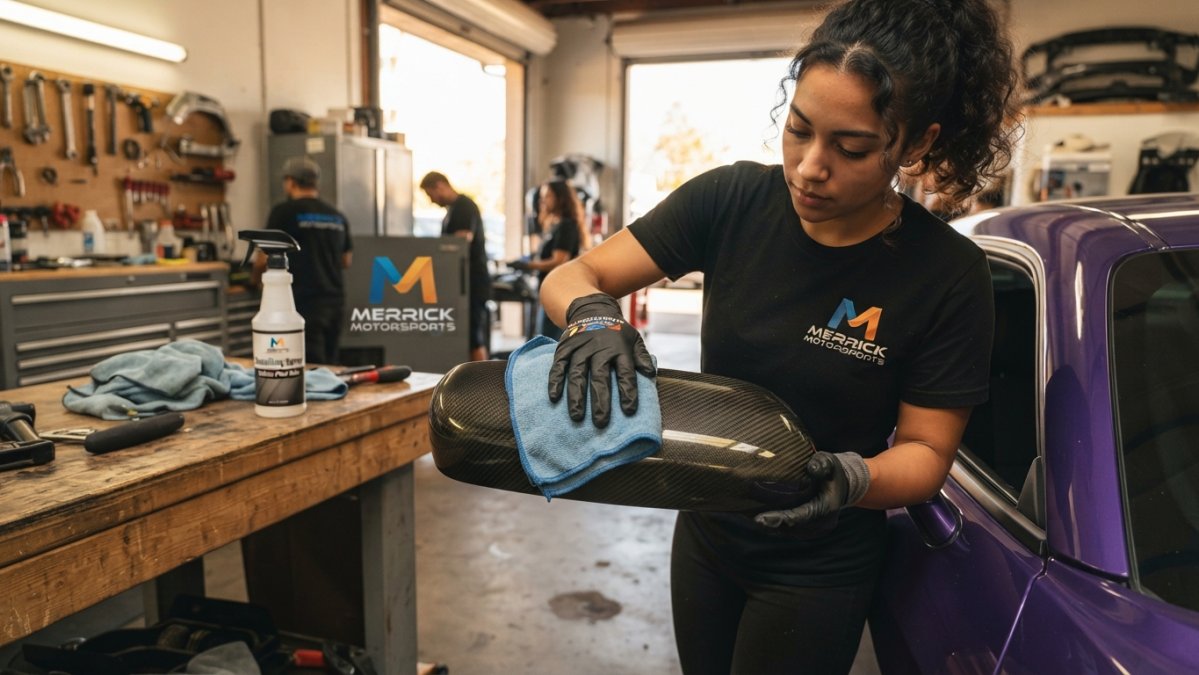
Here's the routine we'd run on any carbon part:
- Rinse off loose grit first. Never dry-wipe a dusty panel.
- Wash with pH-neutral car soap and a soft mitt.
- Rinse thoroughly, then blot dry with a clean microfiber.
- Tackle water spots fast. They etch if you let them bake on.
- Use a fresh cloth per panel to avoid cross-contamination.
That last one is where a tear-away microfiber roll earns its keep. Our BLACKLINE® Carbon Cloth gives you 80 fresh 200 GSM cloths per roll. Grab a clean sheet, wipe, toss it.
A common mistake is washing a hot panel in direct sun. Soap dries before you rinse, and you get spots that look like damage. Wash in shade, on a cool surface.
Carbon Fiber Ceramic Coating: Your First Line of UV Defense
Carbon fiber ceramic coating is a liquid polymer layer that bonds to your clear coat and adds a UV-blocking layer on top. It won't make carbon fiber completely UV-proof, anyone who says otherwise is trying to sell you oceanfront property in Arizona, but it slows yellowing significantly and makes washing easier. Think of it as sunscreen for your weave.
The key word is sacrificial. Ceramic takes the sun damage so your clear coat doesn't. Reapply on schedule and you're replacing cheap protection instead of expensive panels.
The Step-by-Step Ceramic Coating Routine
Here's the product-neutral process most professional detailers follow. Skip a step and you're wasting good money on bad prep.
- Wash and decontaminate. pH-neutral soap, then a clay bar or synthetic decontamination mitt to pull embedded grit. A coating over embedded dirt is like painting over rust.
- Polish out existing haze. Use a fine finishing polish on a soft foam pad. If the yellow doesn't lift, stop, you have resin damage, not surface oxidation, and coating won't fix it.
- Wipe down with isopropyl alcohol. A 10-15% IPA solution removes polishing oils so the coating can bond. Skip this and the coating may fail in weeks.
- Apply thin, level coats in shade. Most consumer coatings want 1-2 coats. Thin is better than thick, high spots haze and look terrible.
- Let it cure fully. Typical cure windows run 24-48 hours before water exposure and 7 days before washing, depending on the product. Read the label; don't guess.
- Maintain with a coating-safe wash. Use a pH-neutral shampoo and avoid wax-heavy toppers that can clog the coating.
How Often to Reapply
Most consumer-grade ceramic coatings on a daily-driven, sun-exposed carbon part need reapplication every 12-24 months. Garage-kept show cars can stretch that. A simple test: if water stops beading tightly and starts sheeting flat, the coating is spent. Reapply before yellowing starts, not after.
What Ceramic Won't Do
- It won't stop rock chips. That's PPF's job.
- It won't make a cheap part with thin clear coat last forever.
- It won't replace shade and garage storage. Physics doesn't care about marketing.
Carbon Fiber Paint Protection Film: The Heavy Armor Option
Carbon fiber paint protection film is a clear urethane layer that physically shields the surface from UV, rock chips, and road grit. Where ceramic is chemistry, PPF is body armor. If you're weighing film for a big sun-baked panel, take a look at the Jeep Grand Cherokee Carbon Fiber Sniper Hood to see the kind of part it's meant to shield. It's the difference between sunscreen and a flak jacket.
PPF pros:
- Blocks UV at the film level
- Takes rock chips that would otherwise star in your nightmares
- Self-heals light scratches with heat
- Removable and replaceable
PPF cons:
- Higher upfront cost than coatings
- Edges can trap dirt if installed poorly
- Needs a skilled installer for a clean look
Best for: daily drivers that live outside. Skip if: your car is a garage queen that only sees car shows.
Wax, Sealants, and Spray Protection: The Budget-Friendly Backups
Wax and sealants are the cheap seats, and there's zero shame in sitting there. A good wax or spray sealant adds a UV-resistant layer and gloss for very little money. The catch is durability. You're reapplying every few weeks, not every few years.
Use them as:
- A top coat over ceramic for extra gloss
- A quick refresh between full coatings
- A stopgap when you're short on time and cash
A common mistake is layering wax over a dirty surface. That's just sealing in grit. Clean first, always.
Spray sealants are the garage-friendly option. Wipe on, buff off, done before your coffee cools. They won't outlast ceramic, but they beat doing nothing by a country mile.
Shade, Storage, and Sun Exposure: The Free Stuff That Actually Works
The best UV protection for carbon fiber costs nothing: park in the shade. Sun exposure is the root cause, so cutting exposure is the highest-value move on this entire list. Parts that sit in constant direct sun, like Jeep Grand Cherokee Dodge Durango Carbon Fiber Mirror Covers, are prime examples of pieces that need UV protection.
Free moves that work:
- Park in a garage or carport when you can
- Use a quality car cover outdoors
- Choose shaded parking over the closest spot
- Avoid leaving the car baking for days at a time
Indoor storage is the gold standard. If your build sits for weeks, a covered garage beats any product on this page. Physics doesn't care about marketing.
How to Evaluate UV Protection Claims Before You Buy
Evaluating UV protection claims comes down to skepticism and a scorecard. If a product promises "complete UV immunity" or "permanent protection," walk away, that's marketing fairy dust. No coating, film, or wax makes carbon fiber completely UV-proof, and honest brands say so.
Here's the unique angle most guides miss: you need to evaluate claims against the specific surface system you're protecting. A clear coat, a gel coat, and raw resin all respond differently to UV. A product that's great for one may be mediocre for another.
The UV Claim Scorecard
Ask these questions before you buy. A product that can't answer most of them is a gamble.
- What exactly is being protected? Clear coat, gel coat, resin, or all three? A product designed for automotive clear coat may not bond well to raw epoxy resin.
- How long does protection last? Real products give real intervals, months or years, not "long-lasting." If the label is vague, assume the worst.
- Is the UV block measured or marketing? Look for specifics like "blocks 99% of UV-A and UV-B" or test standards. Adjectives like "advanced" and "ultimate" mean nothing.
- What maintenance does it need? Everything needs something. A coating that claims zero maintenance is lying.
- Does the brand admit limits? Honesty is a good sign. A brand that says "reapply every 12 months" is more trustworthy than one that says "forever."
- What's the cure or application window? If the instructions are vague, the product is probably vague in performance too.
Match the Product to the Surface
- Factory clear coat: Most ceramic coatings and PPF are designed for this. Check compatibility.
- Gel coat: Marine-grade gel coats may need specific products. Automotive coatings can work but test on a small spot first.
- Raw resin (no coating): This is the wild west. Most consumer products aren't formulated for bare epoxy or polyester resin. A quality UV-resistant clear coat applied by a shop is usually the better path.
Red Flags That Scream "Snake Oil"
- "Permanent UV protection"
- "Works on all surfaces" (nothing does)
- No ingredient or technology description
- No application instructions or cure time
- Reviews that all sound identical
Before you hand over your cash, run every UV claim through this scorecard.
| Question to ask | What good looks like | Red flag |
|---|---|---|
| What is being protected? | Names clear coat, gel coat, or resin | "Works on all surfaces" |
| How long does protection last? | Real intervals in months or years | "Long-lasting" with no specifics |
| Is the UV block measured? | States UV-A and UV-B blocking or test standards | "Advanced" or "ultimate" adjectives |
| What maintenance does it need? | Admits it needs something | Claims zero maintenance |
| Does the brand admit limits? | Says reapply every 12 months | Promises "permanent UV protection" |
| What is the cure window? | Clear application and cure instructions | Vague or missing instructions |
Shopping Carbon Fiber Parts That Won't Fade on You
Shopping smart is the real prevention. A part built with a proper UV-protective clear coat starts the fight with an advantage. A cheap part with a thin coating starts losing on day one.
What to look for:
- Genuine 2x2 twill weave, not a printed overlay
- UV-protective clear coat or gel coat from the factory
- Real fitment data for your model and year
- A warranty that backs the finish
Our 2008+ Dodge Challenger Carbon Fiber Mirror Covers feature genuine 2K twill carbon fiber, high-gloss UV protection, 3M tape installation, and a 6-month warranty.

Want to know how to spot quality construction before you spend a dime? Read our guide on how to identify high quality carbon fiber and walk into your next purchase with your eyes open.
Carbon fiber yellowing isn't a curse, it's a maintenance bill you can mostly avoid. Clean it gently, coat it early, shade it when you can, and buy parts that start with real UV protection. That's the whole game.
At Merrick Motorsports, we stock over 30,000 aftermarket parts with shipping from 6 locations, and we focus hard on Mopar and performance builds. Get started with Merrick Motorsports.
Frequently Asked Questions
Why does carbon fiber turn yellow?
Carbon fiber yellowing is a concern for owners of carbon fiber parts. The appearance and cause can depend on the part and its finish.
Does ceramic coating help prevent carbon fiber yellowing?
Whether a ceramic coating is suitable for a carbon fiber part depends on the product and the part's surface. Follow the coating manufacturer's instructions.
Can paint protection film protect carbon fiber from UV damage?
The supplied product information does not establish whether paint protection film is suitable for a particular carbon fiber part. Check the film manufacturer's specifications and instructions.
How do I fix yellowing carbon fiber once it's already happened?
The supplied product information does not describe a method for diagnosing or repairing yellowed carbon fiber. Consult a qualified professional about the specific part.
