


Dodge Challenger Racing Stripes: Styles, Fit and Install Tips
Quick Summary
Racing stripes on a Dodge Challenger come in rally, Drag Pack and strobe styles, and they're applied as vinyl or carbon fiber kits. Fitment depends on your model year, trim and body style, so confirm those before ordering. Installing them at home is doable with clean prep, a dry-fit and slow squeegeeing.
- Rally stripes wrap over the hood, bumpers and spoiler on Hellcat-style kits.
- Drag Pack and strobe side stripes suit most Challenger colors.
- Choose the widebody version at checkout if your car has widebody flares.
- Dry-fit and mark placement with painter's tape before peeling any backing.
- Wait 24 to 48 hours before washing or using high-pressure spray.
Table of Contents
- Why Racing Stripes Still Turn Heads on a Challenger
- Dodge Challenger Stripe Ideas by Style
- Dodge Challenger OEM Stripes vs. Aftermarket Kits
- Dodge Challenger Hood Stripes: Placement and Fit
- Choosing Stripes by Model Year, Trim and Body Style
- Dodge Challenger Vinyl Stripe Installation, Step by Step
- Troubleshooting Bubbles, Misalignment and Removal
- Ready to Pick Your Stripe Kit at Merrick Motorsports
- Frequently Asked Questions
Why Racing Stripes Still Turn Heads on a Challenger
A set of racing stripes is the cheapest way to make a Dodge Challenger look like it means business. Pull up to a cars-and-coffee meet with a pair of clean stripes running down the hood and roof, and somebody will ask you about it before you've set the parking brake. Dad-approved, garage-tested, and about as subtle as a Hemi rumbling at a red light.
At Merrick Motorsports, we sell a range of stripe kits built for Challenger owners, and we know what separates a sharp stripe job from one that peels, bubbles, or looks like it was applied with a potato. This guide walks through the main styles, how to match a kit to your model year and trim, the difference between OEM and aftermarket stripes, and how to install and troubleshoot them yourself.
Dodge Challenger Stripe Ideas by Style
Stripe styles on the Challenger fall into a few families. Pick the one that matches the car's personality, whether that's a mild-mannered daily or a full-send drag machine.
Rally and Hellcat-Style Stripes
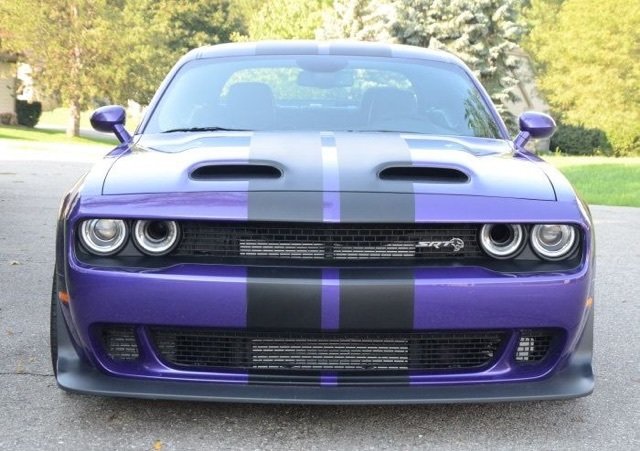
Rally stripes are the most recognizable look on the Challenger. They're a pair of bold lines that wrap over the front end, typically the hood, bumpers, and spoiler area. The Hellcat-style rally kit is built to echo the factory SRT look, and our 2015+ Up Dodge Challenger SRT Hellcat Style Rally Stripe Kit is designed to wrap over the ends of the hood, bumpers, and spoiler. It's priced at $399.95 and is also available in a factory-style carbon fiber material.
For Hellcat and Redeye owners who want the rally look dialed in specifically for their car, our 2019+ Dodge Challenger Hellcat / Hellcat Redeye Style Rally Stripe Kit at $399.95 uses double stripes and works on the hood, bumpers, and spoiler.
Drag Pack and Strobe Side Stripes
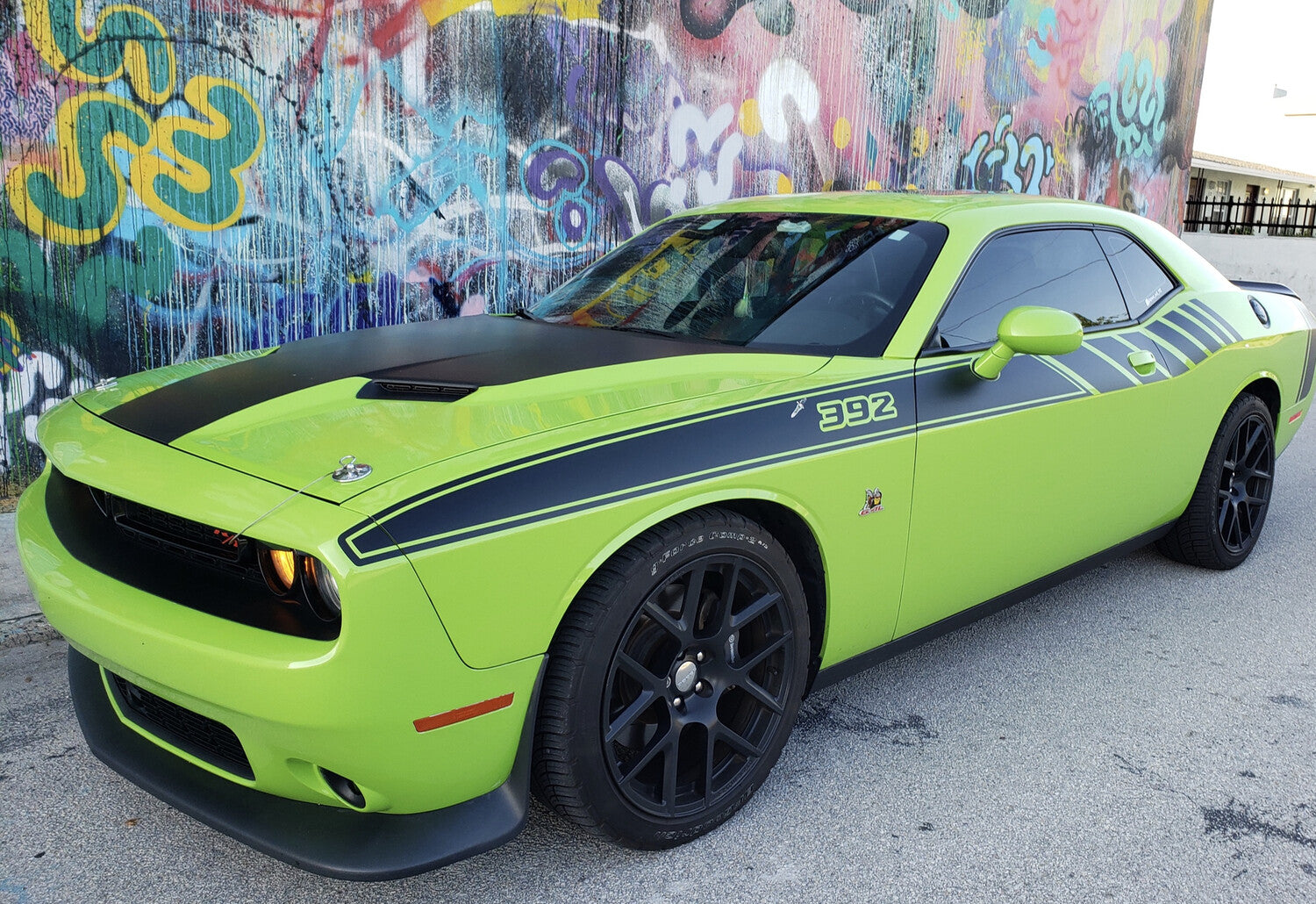
If you want the stripes to run along the body instead of over the front end, side stripes are the way to go. Drag Pack style stripes have a long-running, race-inspired look that works well on a Challenger in almost any color. Our 2008-2019 Drag Pack Style Side Stripe Decal Kit, priced at $249.95, is made to order, and the listing notes that it's available for Widebody Challengers too. Just select Widebody at checkout and the stripes are precut for flare clearance. Note that these decals are custom made to order, so they are not returnable.
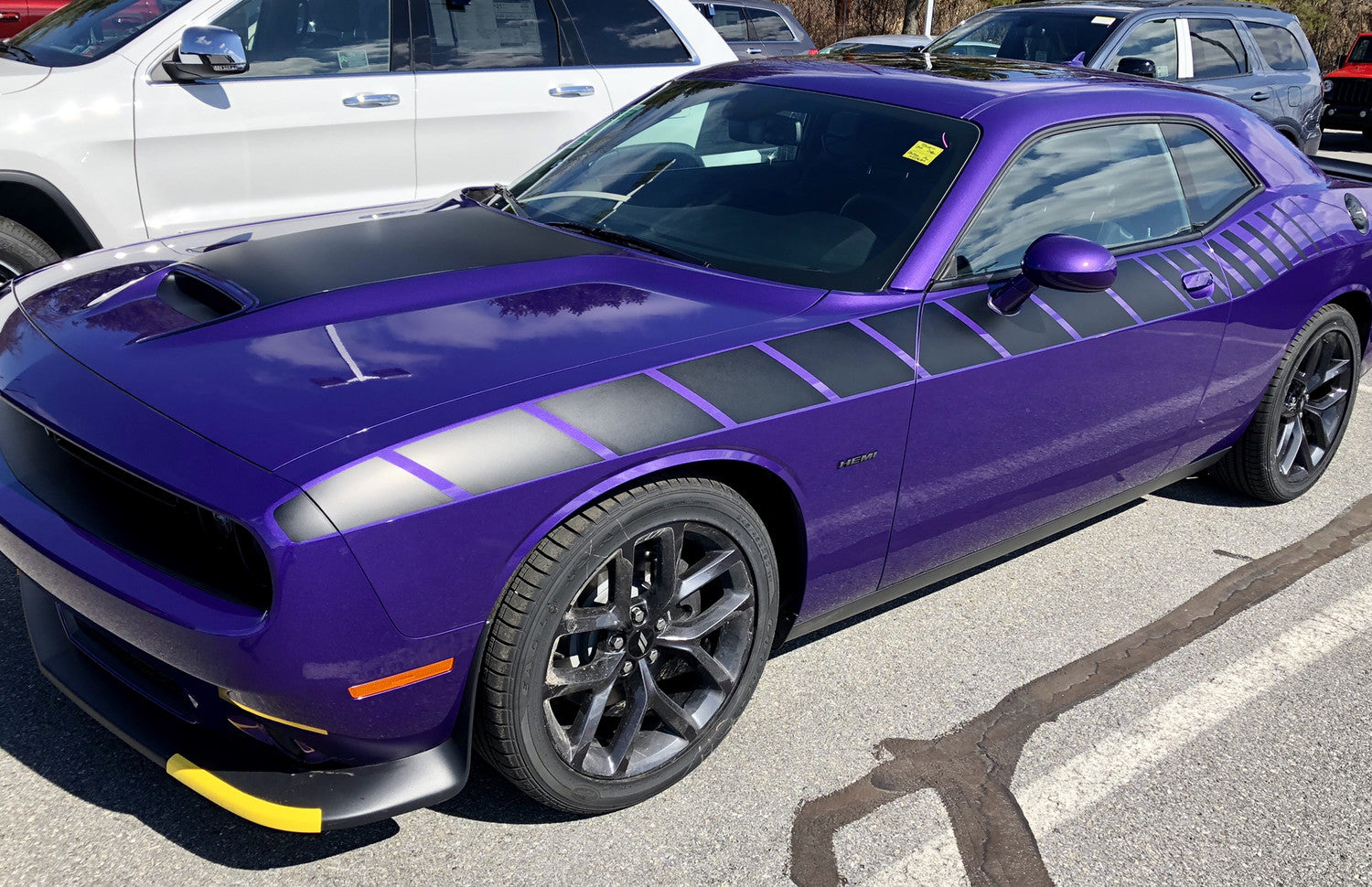
Strobe stripes run a bit shorter and give a cleaner, more modern profile. The 2008+ Dodge Challenger 3/4 Length Strobe Side Stripe Graphics Kit is $249.95 and comes in standard and Widebody versions, so pick the right one when you order.
Dodge Challenger OEM Stripes vs. Aftermarket Kits
Factory stripes from Dodge look excellent, but they come with a premium price and limited options.
Aftermarket kits can give you more choice in styles and colors. The trade-off is quality: look for kits with a known vinyl or carbon fiber material, a clear fitment description for your exact year and body style, and a manufacturer that actually lists which models the kit fits. Cheaper doesn't always mean better value. A kit that doesn't line up with your body lines costs you more in frustration than you saved at checkout.
Just verify the fitment before you buy.
Dodge Challenger Hood Stripes: Placement and Fit
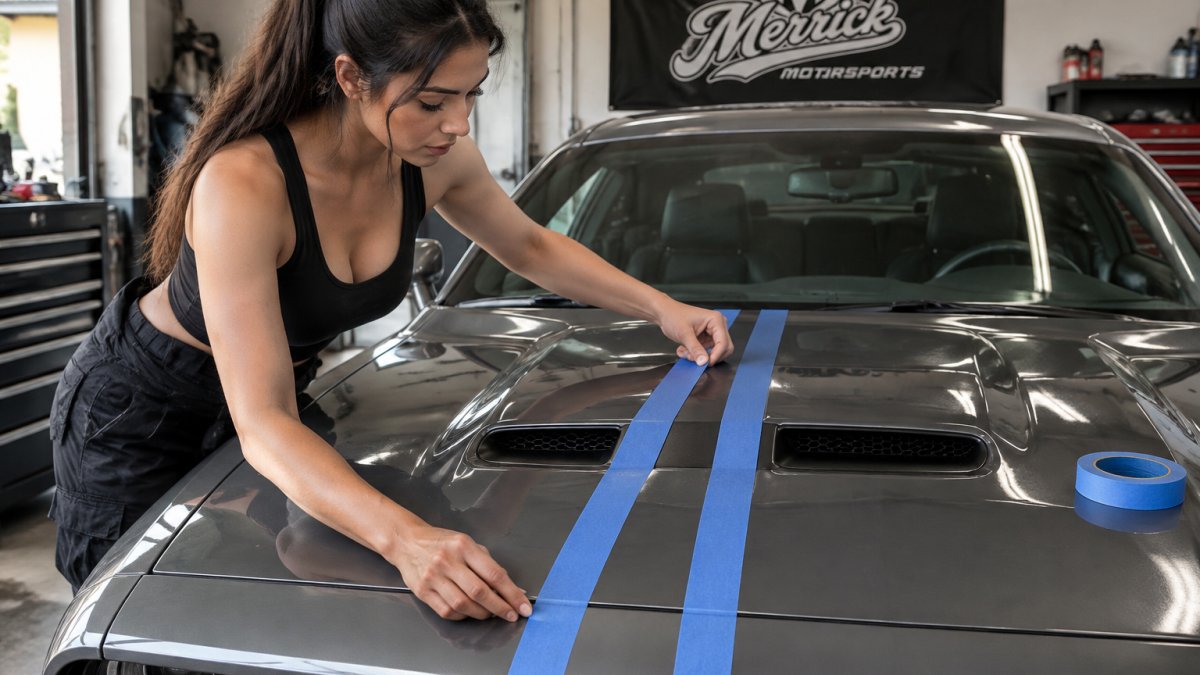
Hood stripes are where most of the visual impact happens, and they're also where fitment mistakes are most obvious. Measure your hood's centerline and the spacing between the stripes before you peel anything. Mark the placement with painter's tape first, step back, and check it from the front and the side.
Hood top-of-scoop graphics are a popular add-on for the Hellcat and Redeye. Our 2019 Dodge Challenger SRT Redeye Hellcat Dual Scoop Hood Top Of Scoop Graphics are made for that specific hood design, so you're not trying to force a generic graphic over the scoop contours. Keep in mind that a stripe that looks perfect on a flat panel can look slightly off on the Challenger's curved hood. Take your time with the layout.
Choosing Stripes by Model Year, Trim and Body Style
Fitment depends on your car's year, trim, and body style. A kit made for a 2015 Hellcat won't necessarily sit right on a 2008 base model, and a widebody needs different flare clearance than a standard car.
Start with these three questions:
- Model year: Confirm the year range printed on the listing. Stripe kits are often grouped by generation, such as 2008-2019 or 2015 and newer.
- Trim: Hellcat, Redeye, Scat Pack, R/T, and GT trims can have different hood and spoiler details. Our 2015 Dodge Challenger Hellcat Scat Pack RT GT Hood Blackout Graphics are built around the hood layouts of those trims.
- Body style: Standard versus widebody matters for side stripes. Choose the correct version at checkout.
If you're not sure, check your exact year, trim, and body style against the product description before you order.
Dodge Challenger Vinyl Stripe Installation, Step by Step
Installing vinyl stripes is very doable at home with patience, a clean workspace, and the right tools. Here's the process we recommend, plus the prep checklist that separates a show-quality job from a wrinkled mess.
What you'll need:
- Your stripe kit
- Painter's tape and a measuring tape
- Isopropyl alcohol and microfiber towels
- A squeegee or felt-edged applicator
- A heat gun or hair dryer
- A spray bottle with soapy water (for repositioning)
- A plastic scraper and adhesive remover (for cleanup)
- A second set of hands (optional but highly recommended)
Surface prep checklist:
- Wash the panel with mild soap and water, then dry it completely.
- Wipe down with isopropyl alcohol to remove wax, oil, and residue.
- Work in a garage or shaded area out of direct sun. Ideal surface temperature is between 60°F and 80°F, too cold and the vinyl won't conform, too hot and it stretches.
- Avoid installing in windy conditions or on a dusty surface.
Steps:
- Clean the surface. Wash the panel, then wipe it down with isopropyl alcohol. Do this on a cool, dry day, ideally in a garage out of direct sun.
- Dry-fit the stripes. Lay the stripes on the car without removing the backing. Mark the position with painter's tape and step back to check alignment from several angles.
- Prep the application area. Lightly mist the panel with soapy water if you want to be able to slide the stripe into position.
- Peel and apply slowly. Remove the backing in small sections and press the stripe down from the center outward, pushing out air as you go.
- Squeegee firmly. Work from the center to the edges to remove bubbles and trapped water.
- Heat the edges. Gently warm the edges and any curved areas with a heat gun on low. This helps the vinyl conform and bond.
- Wait before washing. Let the stripes cure for at least 24 to 48 hours before washing or exposing them to high-pressure spray.
Work slowly on the first stripe. Once you've got the rhythm, the second one goes much faster. And if you're the guy who reads the instructions after the project is done, we see you. Do future-you a favor and read them first.
Troubleshooting Bubbles, Misalignment and Removal
Even careful installers run into trouble, but most problems are fixable. Here's how to handle the common ones, plus what to do when it's time to take the stripes off.
Bubbles: Small air bubbles usually work their way out over a few days in the sun. For larger bubbles, poke a tiny pinhole at the edge with a fine needle and press the air out with a squeegee. Watch out: don't poke through the center of the stripe, always work from an edge so the vinyl doesn't tear.
Wrinkles: Gently lift the stripe, warm the area with a heat gun, and reapply with light pressure. Don't stretch the vinyl, because it will pull back and wrinkle again.
Misalignment: If you catch it quickly, lift the stripe and reposition it while the adhesive is still tacky. Once it's fully bonded, you may need to remove and start over. Watch out: repositioning limits are real, most vinyl adhesives lose tack after two or three lifts, so get it right the first time.
Removal: Heat the stripe with a heat gun and peel it slowly at a low angle. Use an adhesive remover or a plastic scraper to clean up any residue, then wash the area with soap and water. Test any remover on a small hidden spot first to make sure it won't damage the paint. Watch out: never use a metal scraper or harsh solvent on factory paint, you'll trade a stripe problem for a paint problem.
Cost beyond the kit price: Budget for the tools, a heat gun, cleaning supplies, and possibly a second set of hands. The cost of a redo is worth factoring in before you decide to tackle the job yourself. If you're not confident, consider having a professional handle the install. Just don't spend the savings on a new set of tires before the stripes are on.
Ready to Pick Your Stripe Kit at Merrick Motorsports
Racing stripes can be a worthwhile upgrade for a Challenger. The right kit adds personality, fits your car cleanly, and makes the whole car look like it was built with purpose. Whether you want rally stripes for the hood, drag-style side stripes for a classic look, or stripe kits for a Hellcat, check out the options in our catalog. Double-check your year and trim, follow the install steps, and take your time. Then go enjoy the attention at the next meet.
Frequently Asked Questions
How much does a racing stripe cost for a Dodge Challenger?
Costs vary by style and kit type. At Merrick Motorsports, the 2008-2019 Drag Pack Style Side Stripe Decal Kit is $249.95, the 2008+ Dodge Challenger 3/4 Length Strobe Side Stripe Graphics Kit is $249.95, and the 2015+ Hellcat Style Rally Stripe Kit is $399.95. Compare the kit price against how many pieces you need, whether you have a Widebody, and how much time you want to spend on prep and installation before you decide.
Can I install Dodge Challenger vinyl stripes myself?
Yes, most owners with basic patience and a clean garage can handle a vinyl stripe install. Clean the paint thoroughly, work in a dust-free space at a comfortable temperature, and go slowly. Lay the stripe dry first to check alignment, then apply it in sections, using a squeegee to push out air. If the fit feels off, take your time and reposition before the adhesive sets.
Do Dodge Challenger racing stripes come in OEM-style designs?
Yes. The Merrick Motorsports 2019+ Hellcat and Hellcat Redeye Style Rally Stripe Kit is $399.95 and is designed to wrap over the hood, bumpers and spoiler. The 2015+ Hellcat Style Rally Stripe Kit is also available in a factory-style carbon fiber material. Match the design to your trim and model year so the look reads as a factory option.
Do racing stripe kits fit every Dodge Challenger model year?
No. Kits are built for specific model years and body styles, so always confirm the listed years before ordering. Widebody Challengers need extra flare clearance, and Merrick Motorsports will precut stripes for Widebody cars when you select that option at checkout. Check your year, trim and body style against the product description first.
