


Best Dodge Charger Bolt-On Upgrades for 2026
Table of Contents
- What Are Bolt-On Upgrades for a Dodge Charger?
- Quick Comparison Table of Popular Bolt-On Upgrades
- Dodge Charger Cold Air Intake Systems
- Dodge Charger Exhaust Upgrades That Make You Smile
- Brake Performance Kits and Rotors
- Suspension and Handling Upgrades
- Dodge Charger Performance Parts by Year and Trim
- Exterior Styling and Aerodynamic Parts
- Engine Bay Essentials and Protection
- Installation Tips and Common Mistakes to Avoid
- Frequently Asked Questions
Last Updated: October 16, 2026
What Are Bolt-On Upgrades for a Dodge Charger?
Bolt-on upgrades Dodge Charger are exactly what they sound like: parts you can install without cutting, welding, or major modification to your Charger. No trips to the machine shop. No "we're gonna need a bigger garage" moments. Just grab your tools, follow the instructions, and you're done in an afternoon (or two, depending on your coffee intake).

At Merrick Motorsports, we've spent years helping Charger owners sort through the noise and find the parts that actually deliver results. The beauty of bolt-on upgrades is that they're the gateway drug to performance tuning. You get real power gains, better handling, or killer looks without turning your engine bay into a science experiment.
The most popular bolt-on upgrades Dodge Charger fall into a few categories: intake systems that feed your engine cleaner air, exhaust systems that let it breathe out, suspension components that keep you planted in corners, brake kits that actually stop the beast, and styling pieces that make your Charger turn heads before you even fire it up. Some deliver measurable performance. Others are pure theater. Most are somewhere in between, and that's the fun part.
Here's what matters: fitment by year and trim, installation complexity, and whether the upgrade actually does what the marketing promises. We'll walk through the real contenders.
Quick Comparison Table of Popular Bolt-On Upgrades
| Upgrade Type | Starting Price | Best For | Performance Impact |
|---|---|---|---|
| Cold Air Intake | $472-$476 | Daily drivers, weekend warriors | Modest power gain, better throttle response |
| Exhaust System | $1,799-$2,996 | Sound and flow enthusiasts | Real power, aggressive tone |
| Brake Kit | $650 | Track days, spirited driving | Shorter stops, reduced fade |
| Coilover Suspension | $1,412 | Handling-focused builds | Improved cornering, adjustable ride height |
| Wheel Spacers | $246 | Aggressive stance seekers | Wider track, no power gain |
| Carbon Fiber Splitters | $629 | Appearance and aero | Downforce, aggressive look |
| Carbon Fiber Spoiler | $1,149 | Track-focused aesthetics | Rear downforce, visual impact |
| Oil Separator Kit | $169 | Engine protection | Carbon buildup prevention |
Dodge Charger Cold Air Intake Systems
A cold air intake does one thing: it replaces your factory air box with a system designed to pull cooler, denser air into your engine. Cooler air means more oxygen per breath, which means your fuel burns more completely, which means you get more power without a tune.

The K&N 11-23 Dodge Charger NextGen Cold Air Intake is the standout here. It increases airflow by 16.7% and delivers 23.5 horsepower and 18.39 lb-ft of torque with zero tune required. The washable, reusable High-Flow LIFETIME Air Filter means you're not buying new filters every season. Installation takes less than 60 minutes, and the system fits 2011-2023 Chargers across SE, R/T, and Pursuit trims. At $476.96, it's a solid entry point for anyone wanting measurable gains without breaking the bank.

The Airaid 11-23 Dodge Challenger/Charger V6/V8 Performance Air Intake System offers a different philosophy. Instead of relocating the filter, it retains the factory location but replaces the restrictive factory intake tube with a high-flow design. The 360-degree conical Premium Filter is washable and less restrictive than paper. Installation is simple, common hand tools only. At $472.99, it's slightly cheaper than the K&N, and it fits a broader range of Charger and Challenger models from 2011-2023.
Both systems are true bolt-on upgrades. No cutting. No fitment surprises. Both come with everything you need, and both are available through Merrick Motorsports with reliable shipping from multiple US locations.
Dodge Charger Exhaust Upgrades That Make You Smile
This is where bolt-on upgrades get fun. A quality exhaust system doesn't just sound better, it removes backpressure, improves scavenging, and frees up real horsepower. Your Charger breathes easier. Your neighbors know you're home. Win-win.
The Kooks 09-16 Dodge Charger 5.7L Long Tube Headers with Catted Pipe is the real deal. Handcrafted in the USA with stainless steel construction, these headers have been winning championships since 1962. The 1-7/8-inch tubing and 3-inch catted pipe work together to maximize flow without sacrificing emissions compliance. Installation is more involved than an intake, expect 2-4 hours and some basic mechanical skill, but the results are worth it. At $2,996.24, it's a serious investment, but you're getting decades of proven performance engineering.
For something more accessible, the Valvetronic Dodge Charger/Challenger V8 Valved Sport Exhaust System is the Swiss Army knife of exhausts. It features dual-personality engineering: open the valves and you get full-throttle aggression; close them and it's neighbor-friendly quiet. The T304 stainless steel construction is corrosion-resistant, the fitment is direct with no cutting required, and the sound profile is tuned specifically for your engine. At $1,799.99, it's a premium option, but you're getting versatility most systems can't touch. Valvetronic ships in 1-2 weeks, so plan accordingly.


Brake Performance Kits and Rotors
Here's a hard truth: your factory brakes are designed to be reliable and cheap to produce. They're not designed to handle repeated hard stops, track days, or the kind of confidence you want when you're pushing your Charger.
The Power Stop 15-20 Dodge Charger Front Z26 Street Brake Kit is built for exactly that scenario. Drilled and slotted rotors paired with Carbon-Fiber Ceramic pads create shorter stops under demanding conditions. The kit includes everything you need: pads, rotors, stainless-steel hardware, and installation instructions. At $650.17, it's a bolt-on upgrade that actually matters. Fitment is tight for 2015-2020 Chargers across multiple trims, and installation takes 1-2 hours if you've done brake work before.

The genius of this kit is the low-dust, low-noise formula. Your wheels stay cleaner longer, and you're not hearing brake squeal every time you slow down. Real-world benefit: you stop shorter, your brakes fade less, and your daily driving feels more planted.
Suspension and Handling Upgrades
Your Charger rides on a platform designed for comfort and affordability. That means body roll in corners, nose dive under braking, and a general sense that the chassis is doing its own thing. Suspension upgrades fix that.
The Pedders 2015+ Chrysler LD Extreme XA Coilover Kit is engineered specifically for the newer Charger platform. Pedders has been tuning suspension since 1950, and their philosophy is simple: identify what the factory got wrong and fix it (pedders.com). These coilovers lower your center of gravity, reduce body roll, and let you adjust ride height for that aggressive stance. At $1,412.59, they're a serious investment, but you're getting integrated engineering, not just springs and shocks bolted together.

Installation is 3-4 hours if you're comfortable with suspension work. Fitment is precise for 2015+ Chargers with V8 engines (R/T, Scat Pack, Hellcat variants). The result is a Charger that handles like it actually wants to be driven hard.
Eibach Pro-Spacer wheel spacers offer a different approach. At just $246.49 for a 25mm set, they widen your track width, lower your center of gravity slightly, and reduce body roll. They won't transform your handling, but they do give your Charger a more aggressive stance and improve stability. Installation is 30 minutes per wheel. Fitment is broad across 2006-2019 Charger R/T models.

Dodge Charger Performance Parts by Year and Trim
Fitment is everything. A part that fits your 2015 R/T might not fit your 2018 Scat Pack, and vice versa. Engine displacement, trim level, and model year all matter. Get this wrong and you're the guy on the forum asking why his intake doesn't line up with the throttle body. Don't be that guy.
Here's the honest breakdown by generation, because the Charger has worn a few different hats over the years.
2006-2010 (LX platform). The early cars, 2.7L V6, 3.5L V6, 5.7L V8. Bolt-on support is thinner here. Intakes and cat-back exhausts exist, but long-tube headers and coilover kits are harder to source and often need model-specific brackets. If you own one of these, measure twice and order once.
2011-2014 (LD, first refresh). The 3.6L Pentastar V6 and 5.7L Hemi V8 are the main players, plus the SRT8 6.4L. Cold air intakes from K&N and Airaid cover this range. Cat-back exhausts are plentiful. Long-tube headers fit, but check whether the kit is listed for 5.7L or 6.4L, because the flange and port spacing differ. Coilovers are available but fewer tuners build specifically for this window.
2015-2020 (the sweet spot). This is where nearly everything bolts on cleanly. 3.6L V6, 5.7L R/T, 6.4L Scat Pack and SRT, and the 6.2L Hellcat all live here. The K&N intake, Airaid intake, Kooks long-tube headers, Power Stop brake kits, and Pedders coilovers all have direct-fit applications in this range. If you want the least drama and the most options, this is your window.
2021-2023 (current LD). The 3.6L, 5.7L, 6.4L, and 6.2L Hellcat carry over, but the engine bay packaging and some sensor locations changed. Intakes still fit, but verify the listing says 2021+ specifically. Exhaust systems for the Hellcat are their own animal, the valved systems are engineered around the supercharged 6.2L. Suspension parts generally carry over from 2015+, but always confirm the listing covers your exact year.
K&N 11-23 Dodge Charger (5.7L/6.1L V8) NextGen Cold Air Intake →
A quick word on trims. SE and SXT are V6 cars. R/T is the 5.7L V8. Scat Pack and SRT are 6.4L. Hellcat and Redeye are 6.2L supercharged. A part listed for 'Charger V8' usually means 5.7L, not 6.4L, and definitely not 6.2L. That distinction saves you a return shipping label.
How to verify before you buy. Grab your VIN. The 8th character is the engine code, and the 10th is the model year. Cross-reference that against the product's fitment note. If a listing only says '2011-2023 Charger' with no engine breakdown, treat that as a yellow flag and dig deeper. Merrick Motorsports lists fitment details per product, so use that as your reference. A part that doesn't fit is just an expensive paperweight, and nobody wants a $600 paperweight.
Exterior Styling and Aerodynamic Parts
Here's where bolt-on upgrades become pure personality. Your Charger came from the factory looking mean. Styling parts make it look meaner.
The 2015-2023 Dodge Charger Carbon Fiber Wind Splitters from Black Ops Auto Works are functional aero, not just looks. These splitters reduce front-end lift and increase downforce, which means better traction and stability at speed. They're handcrafted in the USA from high-quality carbon fiber with UV-resistant clear coat. Installation takes about an hour. At $629.00, they transform your front end and actually improve handling on track. Fitment is precise for 2015-2023 Chargers across all trims.


The 2015-2024 Dodge Charger Ducktail Spoiler is the rear-end equivalent. Carbon fiber construction, high-gloss finish, direct fitment to OEM mounting points. At $1,149.00, it's a statement piece. Installation is 1-2 hours if you're careful with alignment. The spoiler reduces drag and adds rear downforce, real aerodynamic benefits wrapped in aggressive styling.


Both pieces are made in the USA and designed to work together. If you're building a track-focused Charger or just want your daily driver to look like it means business, these are the upgrades.
Engine Bay Essentials and Protection
Not every upgrade is about power or looks. Some are about keeping your engine healthy long-term.
The Dodge Challenger Charger 300C 5.7 Oil Separator Kit is a perfect example. Your 5.7L Hemi vents crankcase pressure through the PCV valve into the intake. That's normal. What's not normal is the oil vapor that comes along for the ride. Over time, that oil coats your intake valves, creates carbon buildup, and eventually dilutes your fuel, lowering octane levels. The oil separator catches that vapor before it enters the intake, protecting your combustion chambers and keeping your engine running cleaner longer.

At $169.99, it's the cheapest upgrade on this list, and it might be the most valuable. Installation is 15-30 minutes, no special tools required. The kit includes PCV hoses and connectors for plug-and-play simplicity. Fitment is broad: 2005-2024 Challenger, Charger, 300C, or Magnum with the 5.7L V8.
This is the kind of upgrade that doesn't make your Charger faster or louder, but it keeps it running strong for years to come. If you're serious about long-term ownership, install one.
Installation Tips and Common Mistakes to Avoid
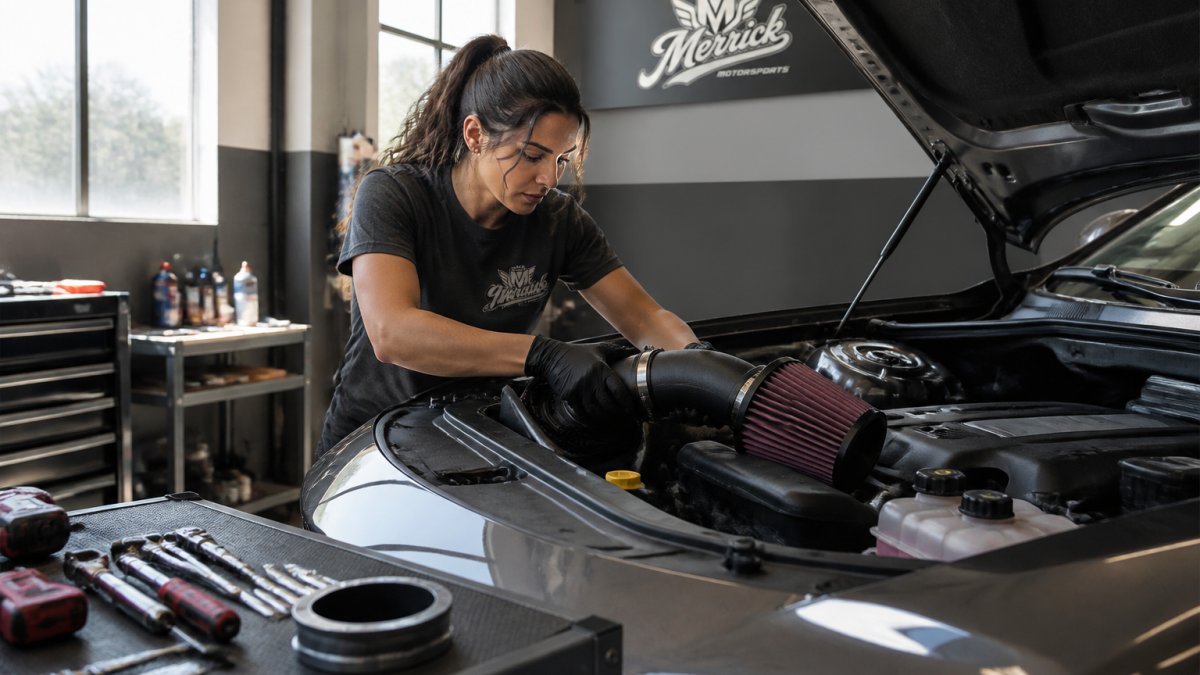
Bolt-on upgrades are called 'bolt-on' for a reason, but that doesn't mean installation is always a walk in the park. Here's what actually matters, broken down by difficulty so you can decide whether to grab a wrench or grab your phone and call a shop.
Difficulty tiers, honestly rated.
Tier 1, driveway-friendly (30-60 minutes). Cold air intakes, oil separators, wheel spacers. Hand tools only. If you can assemble a grill, you can do this. The K&N and Airaid intakes are clamp-and-bolt jobs. The oil separator is 15-30 minutes with basic sockets. Wheel spacers are 30 minutes per corner with a torque wrench.
Tier 2, weekend project (2-4 hours). Cat-back and valved exhaust systems, brake kits, carbon fiber splitters and spoilers. You'll want jack stands, a breaker bar for rusty exhaust bolts, and a torque wrench. Brake jobs need a caliper piston tool or a C-clamp. Splitters and spoilers need a second set of hands for alignment, and a friend who won't drop your $1,149 carbon fiber spoiler on the concrete.
Tier 3, experienced DIY or shop territory (3-6 hours). Coilovers and long-tube headers. Coilovers require spring compressors, an alignment afterward, and patience. Long-tube headers mean dealing with oxygen sensors, heat shielding, and bolts that have been heat-cycled since the car was built. If you've never done headers, budget for a shop. Most independent shops can knock out a header install in an afternoon.
The tool list that actually covers 90% of bolt-ons.
- 3/8-inch drive socket set (metric, 8mm to 19mm)
- Combination wrenches (metric)
- Torque wrench (click-type, 10-150 ft-lb range)
- Jack and jack stands, or ramps for exhaust work
- Breaker bar (for those exhaust bolts that have become one with the car)
- Screwdrivers, both Phillips and flathead
- Nitrile gloves and safety glasses (your knuckles will thank you)
- PB Blaster or similar penetrating oil, for anything exhaust-related
Torque specs matter, don't guess. Intake clamps are snug, not gorilla-tight. Brake caliper bracket bolts are typically in the 80-100 ft-lb range depending on the kit, check the instructions. Lug nuts on most Chargers are around 110-130 ft-lb, but verify for your year. Wheel spacers need to be torqued to the same spec as your lug nuts, then re-checked after 50 miles. Loose bolts rattle, vibrate, and eventually fail. That's how you end up with a wheel passing you on the highway.
Common mistakes, ranked by how much they'll cost you.
- Not disconnecting the battery before touching electrical components. Lights, sensors, anything with a wire. Sparky the ground wire is not your friend.
- Installing parts in the wrong order. If you're doing intake and exhaust, do the intake first. It's easier with the engine bay less crowded.
- Not torquing fasteners to spec. See above. Loose bolts are a countdown timer.
- Not checking fitment before ordering. The VIN is your friend. Use it.
- Rushing. A rushed install is a re-install. Give yourself the full afternoon, not the 45 minutes before your kid's soccer game.
- Forgetting to re-check everything after the first drive. Bolts settle. Clamps shift. Do a 50-mile re-torque on anything safety-related.
Pro move: take photos as you disassemble. Your phone is a free service manual. Reassembly becomes reverse engineering. And when something doesn't look right, you've got your own reference instead of a grainy forum photo from 2009.
Frequently Asked Questions
What bolt-on upgrades can you make to a Dodge Charger?
You can add cold air intakes, exhaust systems, brake kits, suspension upgrades, wheels, spacers, and exterior styling parts like splitters and spoilers. Most bolt-on upgrades require no welding or permanent modifications, they attach directly to factory mounting points. Popular choices include the K&N cold air intake ($476.96), which adds 23.5 horsepower, and the Valvetronic valved exhaust system ($1,799.99) for customizable sound and performance.
Do bolt-on parts increase a Dodge Charger's horsepower?
Yes, certain bolt-on parts deliver measurable power gains. Cold air intakes like the K&N NextGen system add 23.5 hp and 18.39 lb-ft torque with no tune required. Long-tube headers and cat-back exhaust systems also improve horsepower by reducing back pressure and improving airflow. Suspension and brake upgrades don't add power directly but enhance how effectively your Charger uses its existing power on the road or track.
Can you install Dodge Charger bolt-on parts at home?
Most bolt-on upgrades are DIY-friendly. Cold air intakes typically install in under 60 minutes with common hand tools. Wheel spacers, brake pads, and oil separators are similarly straightforward. Exhaust systems and long-tube headers require more skill and may need a lift, so professional installation is recommended for those. Always check fitment details for your specific model year and trim before ordering.
How do I know which aftermarket parts fit my Dodge Charger year and trim?
Check the fitment details on each product listing, they specify exact years, generations, and trim levels (SE, SXT, R/T, Scat Pack, Hellcat, etc.). For example, the K&N cold air intake fits 2011-2023 Charger models including SE, SXT, R/T, and Pursuit trims. The Pedders coilover kit covers 2015+ models with specific engine variants. Always verify your year and trim match before purchasing to avoid returns and frustration.
What are the best first performance mods for a Dodge Charger?
Start with a cold air intake for noticeable power gains ($472-$477) and improved throttle response. Next, add a cat-back exhaust system for sound and airflow benefits. Then consider brake upgrades if you plan hard driving, the Power Stop Z26 kit ($650.17) provides better stopping power and durability. Suspension upgrades like coilovers come later if you want handling improvements. This progression gives you performance, reliability, and value.